
Eggs and cysts of intestinal parasites can survive for several days on textiles. After administering a dewormer to your dog or cat, the treatment alone is not enough to sanitize the immediate environment: sheets, blankets, and covers remain potentially contaminated until they have been properly washed.
Post-deworming excretion: the critical window for sheets and bedding
A dewormer kills or paralyzes adult parasites in the digestive tract, but the excretion of eggs can continue for several days after administration. This is the point that most pet owners underestimate: the swallowed tablet does not instantly sterilize feces or anal secretions that settle on fabrics.
In the case of a Giardia infestation, cysts continue to be excreted even after clinical improvement. We recommend considering the two to three weeks following the start of treatment as a high-risk period for textile contamination.
The same reasoning applies to pinworms, roundworms, and tapeworms. The cycle of reinfestation goes through the environment: a sheet contaminated with microscopic eggs is enough to restart the problem, both for the animal and for the children in the household. To understand when to change the sheets after deworming, one must think in terms of the parasitic cycle rather than simple comfort.
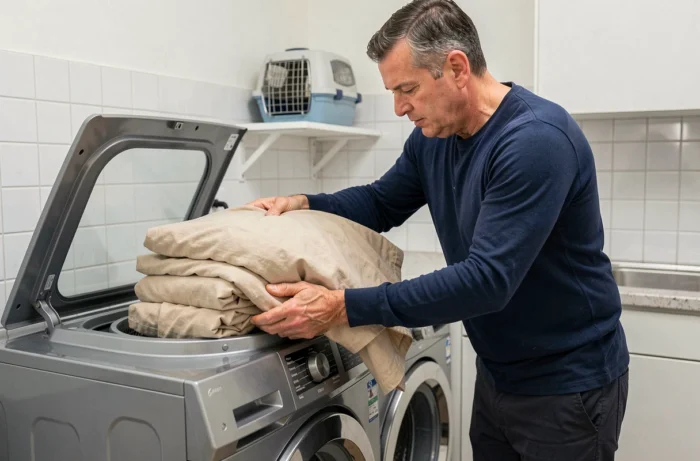
Sheet washing protocol after deworming: temperature and frequency
A warm wash does not destroy intestinal parasite eggs. A high-temperature cycle is the only reliable option to neutralize eggs and cysts on contaminated textiles.
Temperature and product
We recommend washing at a minimum of 60 °C for sheets, pillowcases, and duvet covers. Adding a textile disinfectant (such as diluted bleach or a peroxide-based product) enhances effectiveness against Giardia cysts, which are particularly resistant.
Blankets and throws that cannot withstand this temperature should be put in the dryer on high heat for at least thirty minutes after a regular cycle. Prolonged dry heat partially compensates for insufficient washing temperature.
Frequency during the treatment period
Wash the sheets after every episode of diarrhea and at least every two to three days during the first weeks post-deworming. This frequency applies as long as parasitic excretion remains possible.
- Day of deworming: remove and immediately wash all textiles in contact with the animal (sheets, couch throw, cushion cover from the basket).
- Days 2 to 7: wash every two days if the animal sleeps on the bed or in direct proximity to the bedding.
- Weeks 2 and 3: wash every three to four days, then return to a weekly rhythm if no signs of reinfestation appear.
Parasitic zoonoses: why shared sheets pose a real health risk
Toxocara canis and Toxocara cati are zoonoses transmissible through contact with a contaminated environment. Children who sleep with a recently dewormed dog or cat are the most exposed: hand-to-mouth contact, inhalation of soiled textile fibers, prolonged skin contact with the fabric.
Ocular toxocariasis, although rare, remains a documented complication in children. The risk does not justify panic, but it imposes a rigorous textile protocol during the post-deworming period.
For households with young children, we believe that the animal should not have access to human bedding for the entire duration of the deworming treatment. If this restriction is not feasible, daily sheet changing becomes the only effective barrier.
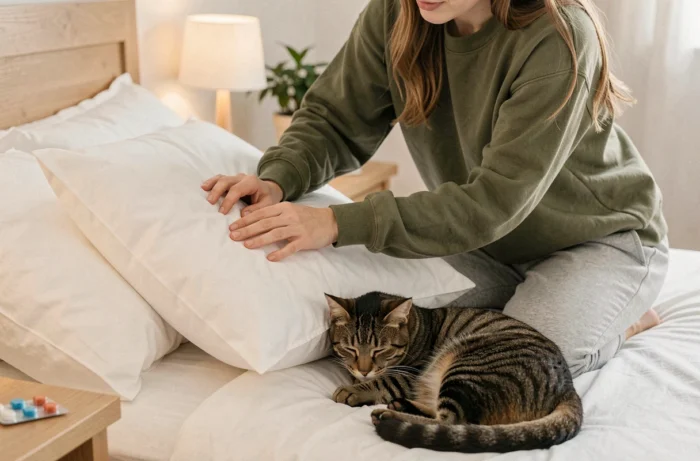
Animal bedding and environment: the textiles we forget to treat
The bed sheets are only part of the problem. The basket, blankets, and rugs concentrate more eggs than human bedding, because the animal spends more time there and rubs directly against them.
- Basket with removable cover: machine wash at 60 °C on the day of deworming, then twice a week for three weeks.
- Basket without removable cover: steam cleaning or thorough vacuuming followed by spraying a disinfectant suitable for textile surfaces.
- Rugs and carpets in sleeping areas: daily vacuuming during the first week, with immediate emptying of the vacuum bag or bin outside the home.
- Couch throws and cushions: treat exactly like the sheets if the animal has access to them.
Failing to treat these textiles means recontaminating the animal after each deworming. The antiparasitic treatment then loses some of its effectiveness, and the reinfestation cycle continues.
Deworming and bedding: adapting the protocol to the type of parasite
Not all intestinal parasites have the same environmental resistance. Roundworm eggs can survive for several weeks in a textile at room temperature. Tapeworm segments, visible to the naked eye, dry out more quickly but release microscopic eggs into the fibers.
Giardia cysts pose a particular problem: they resist many common disinfectants and require a combination of heat and active product to be neutralized. A simple wash at 40 °C with standard detergent is not sufficient in this case.
The choice of textile protocol directly depends on the veterinary diagnosis. After a positive coproscopy for Giardia, the washing requirements are higher than those required after a routine deworming on an animal without confirmed infestation. Ask your veterinarian which parasite has been identified or suspected before calibrating your cleaning program.
A dewormer administered without parallel textile cleaning treats the animal but not its environment. Reinfection from sheets, the basket, or carpets remains the primary cause of apparent failure of antiparasitic treatment in dogs and cats in a domestic setting.