When installing horticultural lighting in a greenhouse already in production, the first constraint is not the budget: it is the compatibility of the light spectrum with the ongoing cultivation cycle. Changing technology during the flowering or cutting campaign requires checking that the new fixture can reproduce or enhance the existing spectral conditions.
This is where VGD LED, a French company specializing in intelligent horticultural lighting, stands out with a tailored approach that goes beyond simply replacing HPS lamps.
Customized VGD LED Spectrum: Control by Independent Channels According to the Crop
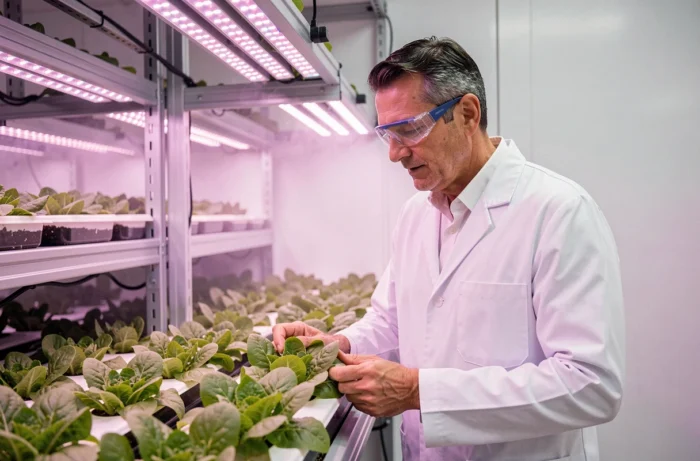
A tomato crop in a greenhouse and a production of young plants in vertical racks do not require the same red/blue ratio. VGD fixtures respond to this reality with control by independent spectral channels, allowing the spectrum to be adjusted without physically intervening on the equipment.
In practical terms, one can increase the far-red component to promote elongation of internodes on cuttings, then switch to a spectrum enriched in blue to achieve a more compact vegetative growth in the next stage. All of this on the same fixture.
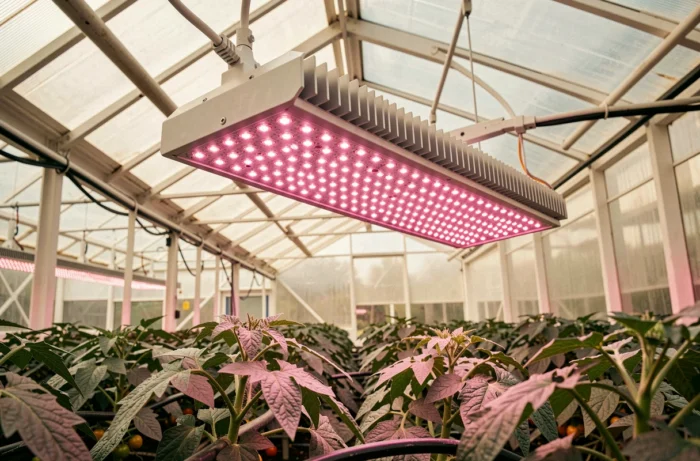
LEDs offer much finer spectral control than HPS, with measurable effects on branching, flowering, and fruit coloration. VGD complements this precision with the ability to design custom spectra, calibrated to a production specification.
When working with vgd led for horticultural lighting, the exchange begins with the cultivation profile, not with a product sheet.
Certification of the Complete Horticultural Fixture: A Often Overlooked Verification Point
Many buyers validate an investment by relying on the certification of the driver or the LEDs taken separately. A certified driver does not guarantee that the assembled fixture complies with the humidity, heat, or photobiological risk constraints encountered in a greenhouse.
The North American standard ANSI/CAN/UL 8800 specifically targets the complete horticultural equipment, not its components taken separately. For an export project or an international specification, this distinction is significant. VGD integrates thermal dissipation management from the design phase of the fixture, targeting compliance on the finished device.
Questions to Ask Before Any Purchase of Horticultural Fixture
- Does the certification concern the assembled fixture, or only the driver and LEDs separately? The answer changes the level of guarantee in real greenhouse conditions.
- Does the manufacturer provide the driver lifespan curve based on temperature, and not just a theoretical value measured under ideal conditions?
- Have performance measurements been conducted at the actual maximum ambient temperature of the installation? Feedback varies on this point among suppliers.
- Does the fixture meet the efficiency threshold defined by the DLC Horticultural Technical Requirements V4.0, effective April 18, 2025, to be eligible for certain aid programs?
This last criterion changes the game. Light efficiency now conditions access to financial aid, beyond the pure performance argument.
Real Durability of Horticultural LED Lighting: The Driver Temperature Changes Everything
It is often stated that the lifespan of an LED fixture is five times that of an HPS lamp. This figure masks a determining parameter: the actual longevity depends on the operating temperature of the driver, not the nominal duration displayed on the technical sheet.
A driver constantly operated above the temperature set for testing loses reliability significantly. In a Mediterranean greenhouse in summer, the temperature at the level of the fixtures far exceeds laboratory conditions. Asking for the measurement temperature and the associated lifespan curve remains a rare reflex in specifications.

VGD works on passive thermal dissipation from the design of its fixtures. This choice directly affects the temperature of the driver in operation, and thus the effective lifespan of the system under real conditions.
VGD LED and Project Support: Solutions Tailored to the Field from France
Buying an LED panel from a generalist site is betting that the power and spectrum will suit the actual configuration. Working with a specialized manufacturer like VGD starts from the greenhouse plan, the type of crop, and the climatic constraints to size the installation. The Racklight range, with its bar format, has been designed for vertical farming in racks, where light distribution must adapt to reduced volumes.
VGD offers standard and custom spectra, with the possibility of consulting their teams to identify the appropriate spectral combination. For an operation that produces both young plants, herbs, and fruit crops, this flexibility avoids multiplying fixture references.
The European market for LED horticultural lighting continues to grow, and technical requirements follow the same trend. Efficiency thresholds for access to aid, certification on the complete fixture, multi-channel spectral control: these criteria mean that entry-level equipment is no longer sufficient to secure a project. Relying on a French manufacturer that masters end-to-end design remains the most direct way to ensure a long-term horticultural investment.