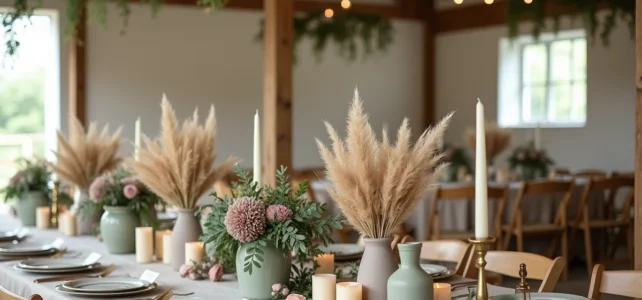
When you start looking for wedding decoration ideas, you quickly come across dozens of moodboards where everything looks the same: fairy lights, eucalyptus, pastel colors. The result is often pretty, but interchangeable. A successful wedding decoration is not just about stacking trendy elements. It tells a specific story, and every choice (flower, material, lighting, signage) carries an intention.
Intentional wedding decoration: giving a role to each element
On the ground, we often see couples accumulating Pinterest inspirations without a guiding thread. The problem arises on the big day: the centerpieces do not communicate with the arch, the signage clashes with the palette, and the atmosphere lacks unity. The opposite approach is to assign a narrative function to each decorative element.
In practical terms, this means starting from an emotion or a moment shared by the couple (a trip, a place, a season) and expressing this story through three registers: materials, colors, and light. A wedding whose common thread is the Mediterranean will not simply place potted olive trees.
It will work with raw terracotta on the tables, warm grazing lighting to evoke the late afternoon, and terracotta or sage green shades that visually anchor the concept.
We also see the rise of earthy palettes and bold colors in the 2026 trends: sage green, burgundy, burnt orange, deep plum. Rather than following these shades because they are popular, it is in our best interest to choose them because they serve the narrative we want to build.
To explore the possible variations of this type of approach, the Mariage et Décoration website offers selections categorized by visual universe, which helps test the coherence of a palette before committing.
Sculpted wedding flowers: the mono-flower bouquet as a choice
The classic reflex is the mixed bouquet with five to eight varieties. It works, but it dilutes the visual message. In 2026, the floral professional press notes a clear trend: high-end mono-flower bouquets are gaining ground, with a marked return of lilies and callas.
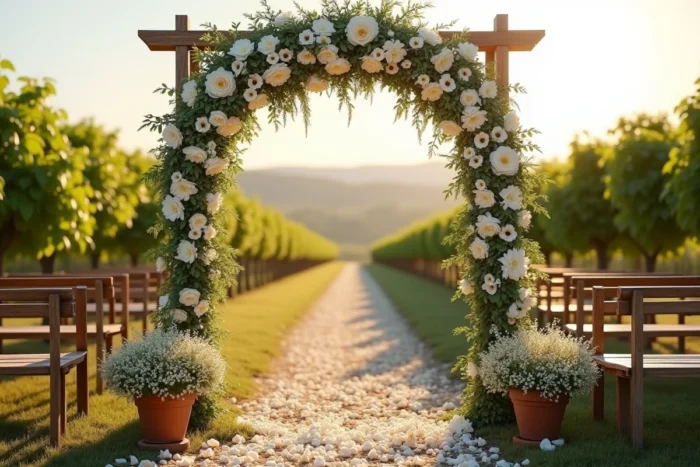
These flowers are not chosen randomly. Their organic, almost sculpted shape creates a strong visual impact with few stems. A bridal bouquet made solely of white callas does not need filler or accessory greenery. It functions as an object in its own right.
This choice logically extends to the tables and the ceremony arch. When opting for a single variety of flower, one can play with:
- The density: a few isolated stems in tinted glass vases for the tables, a generous mass on the arch to mark the focal point of the ceremony.
- The height: low and clean compositions at guest level, high arrangements to structure the reception space without partitioning.
- The contrast with raw materials: a calla on a linen tablecloth, a lily placed on untreated wood, it’s the tension between the refined and the raw that creates emotion.
Feedback varies on this point, as a mono-flower decor requires impeccable execution. Without the right variety at the right stage of blooming, the effect falls flat.
Immersive guest welcome: transforming the entrance into a first impression
The entrance to the reception venue is often underestimated. A welcome sign placed on an easel, and that’s it. Market analyses for 2026 show that this area is becoming a true immersive sensory device: decorative fountains with LEDs, glass or acrylic panels, premium sustainable materials.
The challenge is simple: guests often arrive out of sync, in small groups. Their first impression forms within the first thirty seconds, even before entering the room. A well-thought-out welcome sets the emotional tone for the evening without a word being spoken.
A couple aiming for a nocturnal and intimate atmosphere, for example, can create an access corridor with floor lamps, discreet background music, and a backlit sign. The entrance does not just decorate; it conditions the guests’ state of mind.
Wedding color palette 2026: building contrast rather than harmony
The dominant trend in wedding colors for 2026 is not leaning towards monochromatic tones. There is a clear desire for strong contrast against a backdrop of sophisticated neutrals. Sage green remains the flagship color, but it is increasingly paired with dense shades like burgundy, teal, or periwinkle (deep lavender blue).
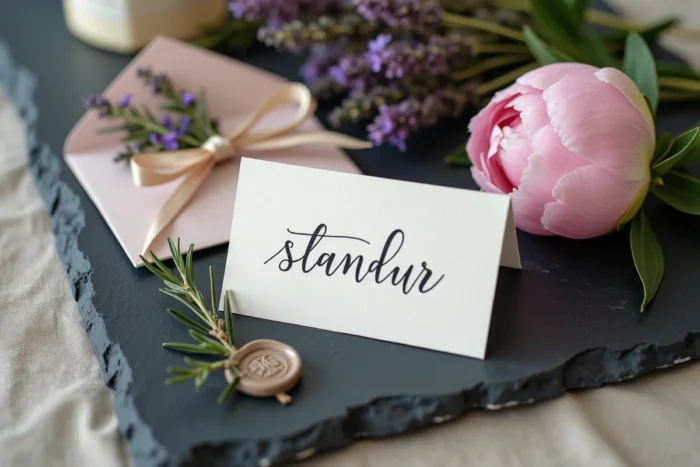
This type of palette requires precise distribution. If burgundy is everywhere, the space becomes heavy. The logic that works on the ground is that of ratio: a dominant neutral (linen, off-white, greige) covering most surfaces, an anchoring color (sage green, terracotta) on textiles and stationery, and a bright accent (plum, burnt orange) reserved for a few strategic points.
These strategic points are the elements that the eye catches first:
- The napkins placed on the plates, as they are at the center of the visual field when sitting down.
- The bride’s bouquet, which appears in most of the day’s photos.
- The ribbons or ties of the ceremony arch, visible from all guest seats.
Three points of strong color are enough to structure the entire space, as long as they are placed where the gaze naturally falls.
Rather than chasing every decorative novelty, a memorable wedding rests on limited but coherent choices. One flower, a mastered palette, an entrance that already tells the story: the rest follows.