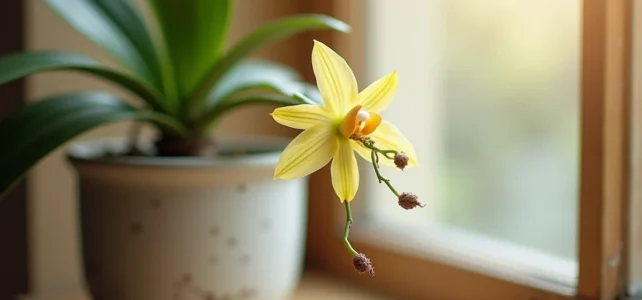
Your Phalaenopsis orchid has a stem that is turning yellow, and the flowers are starting to fall one by one. Before cutting everything or urgently changing the pot, it is important to understand what the plant is expressing. The yellowing of a flower spike does not always have the same origin, and the response depends on what you observe on the roots, leaves, and substrate.
Iron Chlorosis and Hard Water: The Cause Few Guides Mention
Most articles on orchids point to overwatering or lack of light. These two factors do play a role, but they sometimes mask a more subtle problem: the quality of the watering water.
Have you noticed a whitish deposit on the edge of the pot or on the surface of the substrate? That’s limescale. Very hard water raises the pH of the substrate, which blocks the absorption of iron by the roots. Without iron, the plant cannot produce enough chlorophyll. The stem pales, and the leaves do too. This is called iron chlorosis.
To determine if your orchid is suffering from this problem, observe the yellowing. It is diffuse and gradual. It affects the flower spike and the leaves at the same time. The roots may appear fine. If you have been watering for months with tap water in a hard water area, that’s a clear signal. It is useful to understand what to do if the orchid’s stem turns yellow in this specific situation.
The solution: switch to low-mineral water (filtered rainwater or bottled water with low dry residue). Within a few weeks, the substrate will regain a pH compatible with iron absorption, and the plant will stop yellowing.
Yellow Orchid Stem After Flowering: Cut or Wait
When the last flower falls, the spike often begins to dry from the top. This yellowing is natural. The plant is recovering the nutrients stored in the stem before abandoning it. Nothing alarming.
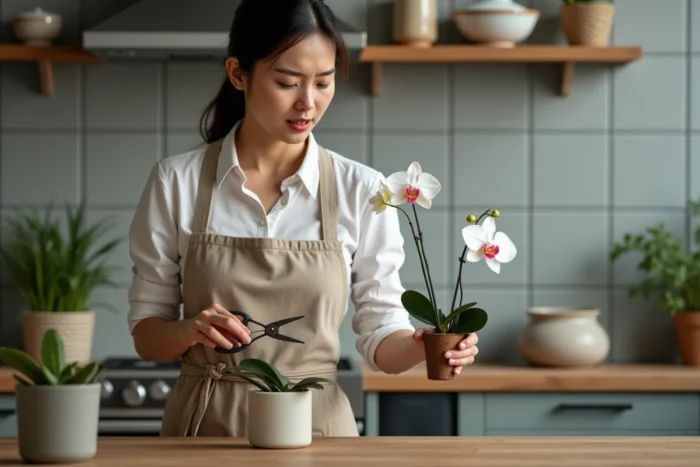
The question then arises: should you cut it right away? A clearly yellow, brown, or soft spike will not produce flowers again. Horticulturists recommend cutting it back to the base with clean, sterilized pruning shears.
Spike Still Green with a Yellow Segment
If only the upper part is yellow and the rest of the stem remains green, cut above the last green node. A new shoot may emerge and produce a second flowering.
Entirely Yellow and Dry Spike
Cut it back to the base. The plant will then redirect its energy to the leaves and roots, preparing for the next flower spike. Keeping a dead stem serves no purpose: it will not turn green again.
Immersion Watering: The Method That Protects Roots and Stems
Excess water is the primary cause of root rot in Phalaenopsis. Rotting roots no longer nourish the plant. The stem turns yellow, the leaves soften, and without quick intervention, the orchid dies.
The problem often lies in the action: pouring a glass of water onto the substrate wets it unevenly. Some roots remain dry while others are constantly submerged. Controlled immersion watering significantly reduces this risk.
Here’s how to proceed:
- Submerge the pot (with its drainage holes) in a basin of lukewarm, non-hard water for ten to fifteen minutes
- Let it drain completely before placing the pot back in its cache-pot, without stagnant water at the bottom
- Do not rely on a schedule: water when the visible roots turn silvery gray and the pot feels light to the touch
Healthy roots are green or white and firm. If they are dark brown, soft, or slimy, rot has set in. You should remove the dead roots with a sterilized tool, let the base dry for a few hours, and repot in fresh bark-based substrate.
Light and Placement: Where to Place the Orchid to Avoid Yellowing
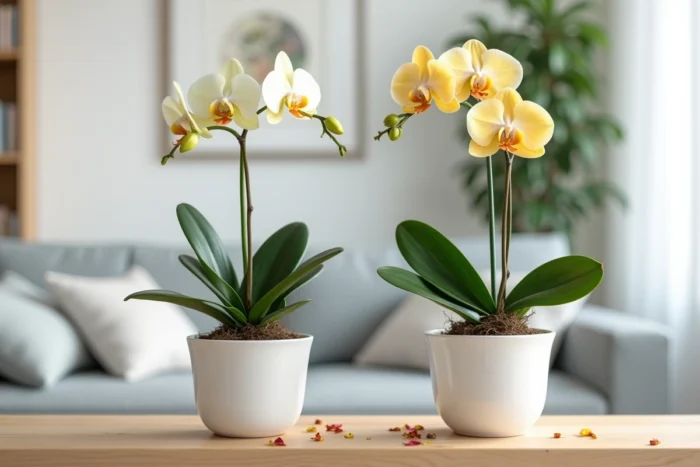
An orchid placed in full sun behind a south-facing window can develop burns. The leaves show localized yellow spots, and the spike dries prematurely. Conversely, a location that is too dark causes the stem to stretch: it elongates, pales, and eventually turns yellow without producing many flowers.
An east or west-facing window provides the most reliable exposure. The light remains indirect but stable, limiting both extremes. If your only option is a south-facing window, a light curtain is enough to filter direct rays during the hottest hours.
Signs to Watch for Depending on Exposure
- Localized yellow spots on the leaves: too much direct sunlight, move the pot away or add a filter
- Stem growing at a strong angle towards the window: insufficient light, move the plant closer
- Very dark green leaves: the plant compensates for a lack of light by producing more chlorophyll, a sign that it is lacking in light
Substrate and Repotting: When the Support Suffocates the Roots
The substrate of a Phalaenopsis orchid decomposes over time. The bark compacts, retains too much moisture, and no longer allows air to circulate around the roots. This phenomenon promotes root rot, leading to the yellowing of stems and leaves.
Repot approximately every two years, or as soon as the substrate appears compact and spongy. Use a medium-grade pine bark mix, suitable for epiphytic orchids. Regular potting soils are too dense and retain too much water for this type of plant.
Choose a transparent pot: it allows you to monitor the condition of the roots and judge the right time to water by observing their color. An opaque pot provides no visual indication, increasing the risk of error.
A yellowing orchid stem always tells something specific. Degraded substrate, hard water, suffocated roots, or simply the end of flowering: each case calls for a different action. Look at the roots, touch the substrate, check the quality of your water. These three reflexes are enough to make the right diagnosis before reaching for the pruning shears.