DIY at home and decorating your interior involve two different logics, but the most successful projects often arise at their intersection. Knowing how to install wall coverings, choose a paint suitable for the room, or transform an existing piece of furniture requires a minimum of method and technical knowledge. The home improvement market is also evolving due to new regulatory obligations, particularly regarding the reuse of materials and the management of construction waste.
Reuse and the AGEC Law: What Changes for Your Renovation Projects
Before rushing to the store to buy new items, regulations now encourage considering what already exists. The AGEC law requires relevant retailers to accept many products for free: furniture, bedding, DIY and gardening items. For individuals, this means easier access to second-hand materials and furniture.
The Ecomaison sector, in a publication dated September 1, 2026, emphasizes the importance of donating furniture and items that are still in good condition rather than throwing them away. It relies on a network of 630 partner associations to organize this collection. Specifically, before starting a living room or bedroom makeover, checking local donation and resale platforms can provide furniture pieces to transform yourself.
For larger projects, the PEMD diagnosis (products, equipment, materials, and waste) applies to operations exceeding 1,000 m² of cumulative floor area. This framework mainly concerns heavy renovation or demolition, but it illustrates a fundamental trend: identifying what can be reused before demolishing or replacing. Resources like bricodeco-solution.com document these approaches that combine DIY, decoration, and reuse.
Hybrid Renovation: Which Decoration Work to Do Yourself
Not all tasks are equally feasible for an individual. The so-called hybrid renovation strategy involves clearly distinguishing between accessible finishes and interventions that require a qualified professional.
Decoration Work That Can Be Done Without a Professional
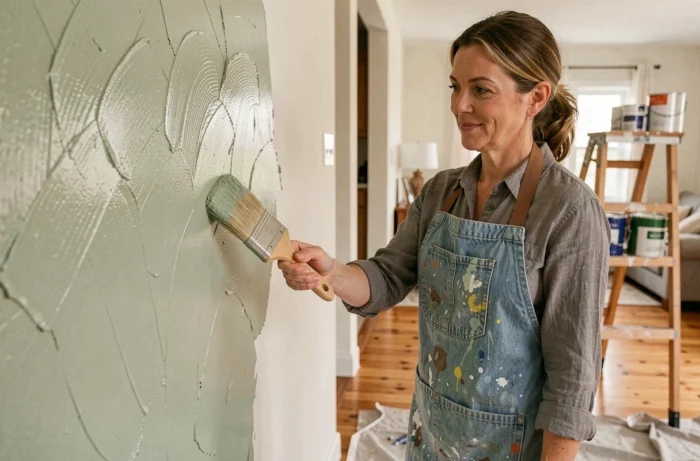
- Wall painting remains the most common DIY project. Properly preparing the surface (washing, light sanding, primer) is more crucial for the durability of the result than the choice of paint brand.
- Applying wallpaper or adhesive wall coverings requires minimal tools: a cutter, a smoothing spatula, a level, and a tape measure are sufficient.
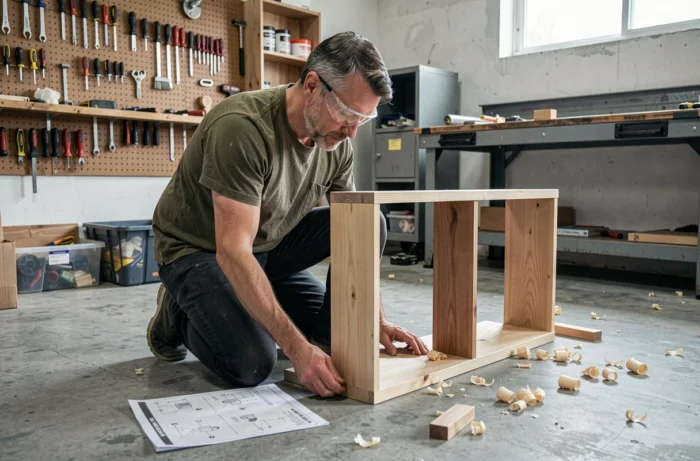
- Installing shelves, assembling flat-pack furniture, and laying click-lock laminate flooring are light carpentry tasks accessible with well-constructed tutorials and basic tools.
- Replacing furniture handles, simple light fixtures (without modifying the electrical circuit), or visible faucets transforms a room at a low cost.
Work to Entrust to a Qualified Craftsman
Electricity, gas, connected plumbing, load-bearing structures, and exterior insulation must remain in the hands of professionals. Attempting these tasks yourself can invalidate home insurance and jeopardize access to certain financial aids related to energy renovation.
This distinction is often blurred in general DIY guides. Field feedback varies on this point: some experienced DIYers install a secondary electrical panel themselves, but in the event of a disaster, the lack of a compliance certificate from an accredited organization poses a real insurance problem.
Interior Painting and Wall Decoration: Prepare the Surface Above All
Painting is the most frequent DIY decoration task and the one where preparation errors are the most costly. A poorly prepared wall results in blisters, visible roller marks, and a finish that deteriorates quickly within months.
Sanding and filling holes are the critical phases. A filler applied too thickly shrinks as it dries and creates visible dips under the paint. Applying several thin layers, allowing to dry between each pass, yields a much smoother result.
The choice between matte, satin, or glossy paint depends as much on the room’s use as on the desired style. A satin finish in the kitchen or bathroom withstands splashes better and is easier to clean. In contrast, a matte finish better conceals surface imperfections in a living room or bedroom.

Wooden Interior Design: DIY Projects with High Decorative Value
Wood remains the most versatile material for DIY home decoration projects. Custom shelves, a headboard made from slats, wall cladding with wooden boards: these creations add texture and warmth to an interior without requiring advanced carpentry skills.
A successful wood project relies on three initial choices: the type of wood (pine, oak, beech, or reclaimed wood), the finish (varnish, oil, stain, or paint), and the appropriate fixing method for the wall support. Fixing battens to a drywall with unsuitable anchors can cause them to pull away under weight, a recurring issue in feedback from amateur DIYers.
Upcycling wooden furniture directly aligns with the reuse logic encouraged by the AGEC law. Sanding and repainting an old dresser, replacing its handles, and adding a self-adhesive marble top transforms a dated piece into a contemporary one. The cost is limited to a few supplies, and the result remains unique.
Basic Tools to Start DIY Decoration
Accumulating tools without a method is a common pitfall. To cover the majority of interior decoration projects, a limited kit is sufficient:
- A cordless drill-driver (the versatility of this tool makes it the first purchase to consider)
- A level, a tape measure, and a carpenter’s pencil for marking
- A sanding kit (manual sanding block for small surfaces, orbital sander for furniture)
- A set of screwdrivers, a pair of pliers, and a hammer
- Medium-quality brushes and a roller suitable for the surface (lacquer for woodwork, drip-free for walls)
Investing in a good roller and quality brushes changes the result more than investing in high-end paint. A low-quality roller sheds fibers on the wall and leaves marks that even two additional coats cannot correct.
The success of a DIY home improvement and decoration project rarely depends on the overall budget. It relies on the time spent on preparation, the choice of the right materials for the right use, and the ability to recognize when a professional should take over. The most satisfying projects are those where each step has been anticipated before touching a tool.