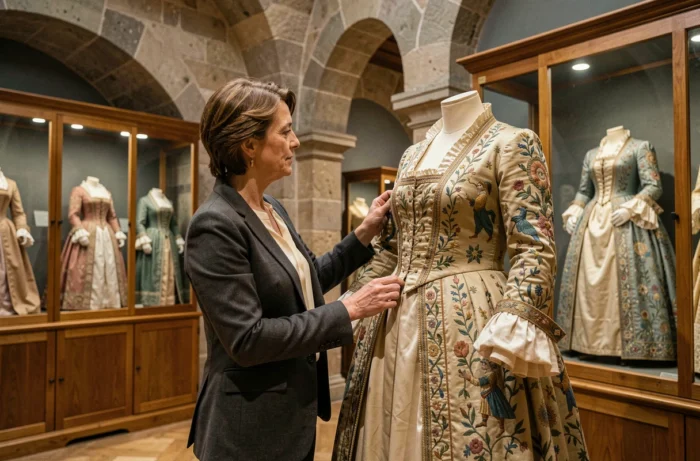
Fashion refers to a system of cyclical renewal of clothing forms, distinct from the simple need for covering oneself. Before becoming an industry or a media phenomenon, it functioned for millennia as a visual language linked to status, climate, and locally available materials. Understanding its origins means going back well before the first Parisian fashion shows, to prehistoric adornments that already marked an aesthetic intention.
Fabric, dyeing, and climate: the constraints that shaped clothing
Competitors largely address prehistory and antiquity from a chronological perspective. A less frequently discussed aspect is the determining role of local textile resources in the diversification of styles. Each region had access only to its own fibers: linen in Egypt, wool in Mesopotamia, silk in China. These material constraints produced radically different silhouettes from one continent to another.
Dyeing played a comparable role. Tyrian purple, extracted from murex, was so expensive that it became a marker of imperial power. Pastel blue, cultivated in medieval southern France, enriched entire regions. The color of a garment indicated social rank even before its cut.
Climate also dictated structural choices. The loose drapes of Mediterranean civilizations responded to the heat, while the fitted and layered clothing of northern peoples protected against the cold. These two logics, draping versus tailoring, coexisted for centuries before blending through trade exchanges.
To delve deeper into the origins and evolution on Mode in Paris, it is essential to keep in mind this link between geography and clothing style, which explains why fashion has never had a single center of gravity.

Aristocratic fashion and the emergence of Parisian style in the 17th century
Modern fashion, with its cycles of trends and deliberate obsolescence, was born in European courts. Under Louis XIV, Paris became the capital of clothing elegance through a deliberate political effort. The king imposed a dress code at Versailles that served both as social control and as a showcase for French silk and lace manufactures.
What distinguishes this period is the emergence of the notion of season in fashion. Aristocrats changed their wardrobes several times a year, not due to wear, but out of a concern for novelty. Parisian gazettes spread trends across Europe, creating a first transnational network of fashion influence.
The role of accessories in the dissemination of trends
Dresses and coats traveled poorly, but accessories circulated quickly. Ribbons, fans, wigs, and hats crossed borders more easily than complete garments. They functioned as trend vectors long before magazines.
- Powdered wigs, adopted in all European courts, standardized male appearance beyond national borders.
- Painted fans served both as a fashion accessory and as a medium for visual communication, sometimes political.
- Printed fabrics (indiennes) imported from Asia triggered trade bans in France, proof of their impact on the local market.
Parisian couture and the birth of contemporary fashion in the 19th century
The 19th century marks a technical and commercial break. Haute couture transforms clothing into a signed creation, with an identified designer, collections presented on fixed dates, and an international clientele. Paris then consolidates its status as the global fashion capital, a positioning that endures.
Industrialization also changes the game for the rest of the population. Sewing machines and mass production make clothing accessible to the middle class. Popular fashion emerges, distinct from haute couture but influenced by it, with a lag of a few seasons.
Women and the evolution of silhouettes
The feminine silhouettes of the 19th century illustrate how fashion reflects social norms. The corset, omnipresent for decades, imposes a constricted waist that limits movement. Its gradual questioning accompanies the first feminist claims. The abandonment of the corset at the beginning of the 20th century liberates the feminine silhouette and paves the way for the flowing dresses of the 1920s.
European regulation and traceability: fashion enters a new era
The evolution of fashion is no longer measured solely in cuts and trends. The European regulation on the eco-design of sustainable products, adopted in June 2024 and coming into force on July 18, 2024, creates the legal framework for the digital product passport. For clothing, detailed obligations are yet to be established by a specific act.
This regulation also establishes a gradual ban on the destruction of unsold clothing and accessories. It applies to large companies starting from July 19, 2026, and then to medium-sized enterprises from July 19, 2030. Affected companies will have to publish information on the volumes destroyed.
Since December 13, 2024, another European regulation regarding general product safety requires brands to conduct risk assessments and provide traceability information. For sellers established outside the European Union, the designation of a responsible economic operator in the EU becomes mandatory.
- The digital passport aims to document the composition, origin, and environmental impact of each garment sold in the EU.
- The ban on the destruction of unsold items shifts from a voluntary commitment to a legal obligation with specific deadlines.
- Second-hand and repair gain a regulatory framework that integrates them into the official textile economy.
Fashion has traversed millennia by adapting to materials, political powers, and production techniques. The next transformation is regulatory. Brands selling in Europe will need to document the life cycle of their products, a technical constraint that will change the design of clothing long before it changes the shop windows.