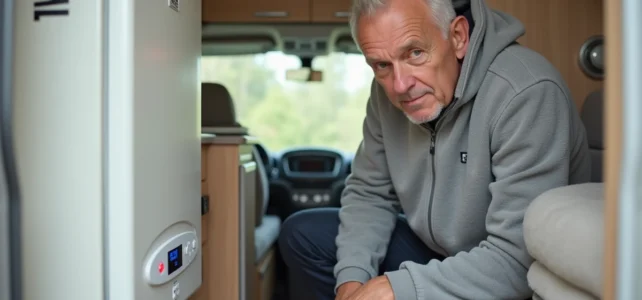
A Truma error code displayed on the CP Plus panel does not always mean that the heating system is faulty. In most cases we encounter in the workshop, the fault comes from a peripheral element (power supply, gas circuit, corroded connections) and not from the Combi itself. Knowing how to read the prefix of the code before disassembling anything can save hours of unnecessary diagnostics.
Battery voltage and gas circuit: sorting before any intervention on the Truma Combi
A Truma Combi 4 or 6 will not tolerate a 12 V power supply voltage below the operating threshold. When the auxiliary battery drops too low, the control panel displays a code of type W255H, indicating unstable power supply. Before suspecting an internal fault, we recommend measuring the voltage directly at the terminals of the auxiliary battery, with the engine off.
Next, check the fuses dedicated to the heating system on the auxiliary distribution panel. A loose terminal or a worn fuse is enough to cause intermittent undervoltage that the system interprets as a complete failure. Also check the condition of the wiring between the battery and the Combi: a voltage drop in a wire of insufficient gauge or a corroded connection produces the same symptom.
On the gas side, the code W517H indicates a lack of flame detection related to the gas supply. Before blaming the ignition electrode, review these points:
- Gas bottle open and not empty, regulator properly screwed in and suitable for the type of gas used (butane or propane depending on the season).
- Gas rail shut-off valve in the open position, including intermediate valves if the vehicle has them.
- Gas hose within its validity period, without kinks or crushing between the storage compartment and the Combi.
A W517H that disappears after checking the gas circuit confirms that the Truma heating was not at fault. We observe this scenario very regularly after winter storage, when the pressure regulator remains stuck due to residual frost or when the bottle has been changed without purging the line.
To delve deeper into each code and its resolution procedure, the list of Truma error codes details step-by-step diagnostics, from simple reset to component replacement.
Reading the prefix of the Truma error code: W, E, and the suffix H decoded
Not all codes displayed on the CP Plus panel are equal. The prefix determines the severity and guides the approach.
A code starting with W (Warning) indicates a reversible warning. The system has detected an anomaly but is still able to restart after correction. The W255H and W517H mentioned above are the most common examples. A simple reset often suffices once the cause is addressed.
A code starting with E (Error) indicates a hardware fault locking the heating system. The E133H points to a short circuit on the combustion air motor, while the E515H indicates an abnormally low motor speed. These errors require the replacement of the implicated component. Restarting the Combi without intervention will only reproduce the blockage.
The suffix H specifies that the fault concerns the heating part (Heating). On a mixed heating/hot water Combi, this distinction allows one to know immediately if the hot water circuit remains functional despite the displayed error.
Simple numeric codes on older panels
Older control panels (without LCD screens) use a flashing system. Code 1 corresponds to a flame not detected, Code 2 to a sensor fault (EOS or BOS). Count the number of LED flashes, then refer to the technical documentation for your model. The logic remains the same: identify whether the problem comes from the power supply, the sensor, or the burner.
Truma reset procedure: when it works and when it masks a real fault
The reset is the first action that any user attempts. On a CP Plus panel, it is done by turning off the heating, waiting a few seconds, and then restarting it. This action clears Warning-type codes and restarts the ignition cycle.
A reset resolves the issue in two specific cases: the W code was related to a temporary disturbance (voltage drop during the starting of the vehicle engine, micro-gas cut) or the cause has been corrected in the meantime (bottle replaced, fuse changed).
On the other hand, a reappearing E code after a reset confirms a persistent hardware fault. Restarting the Combi in a loop in this situation unnecessarily stresses the burner and ignition circuit. After several unsuccessful attempts, the system goes into safety lockout, requiring intervention at an authorized Truma workshop.
We recommend systematically noting three pieces of information before contacting a repairer:
- The exact code displayed (prefix, number, suffix), recorded before the reset.
- The duration of operation before the fault appeared and the mode used (heating only, hot water, mixed).
- The outside temperature at the time of the fault, which influences gas pressure and battery charge.
This data allows the technician to distinguish between an intermittent fault related to usage conditions and a complete failure of a component. A reproducible E133H at each attempt points towards a motor replacement. A W517H that only appears in cold weather suggests a problem with the regulator or an unsuitable type of gas.
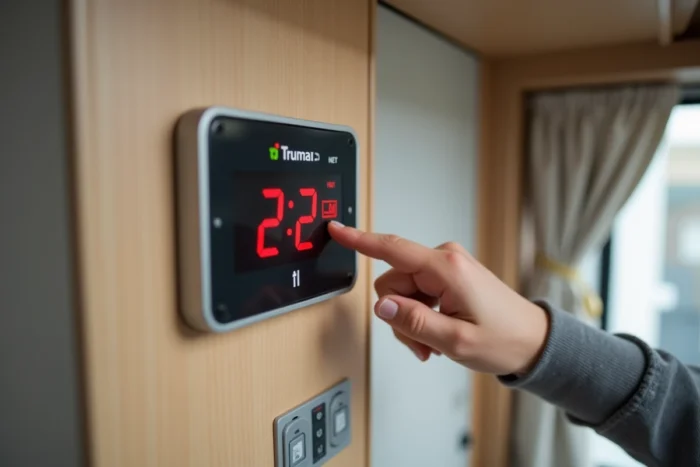
When the Truma error code justifies a visit to an authorized workshop
Any E-type error persisting after a reset and a check of the 12 V and gas supply requires professional diagnosis. Replacing a combustion air motor, ignition electrode, or EOS sensor involves partial disassembly of the Combi and a gas tightness check after reassembly.
Recurring W codes also deserve special attention. A W255H that returns with each startup, even with a charged battery, may mask a fault in the vehicle’s wiring harness or a faulty ground connection. This type of fault cannot be resolved with a multimeter alone.
The cost of a diagnosis at an authorized workshop is much lower than that of an electronic board replacement mistakenly performed on a Combi whose real problem was a punctured gas hose or an intermittent fuse. Always start with peripheral checks before incurring expenses on the heating system itself.