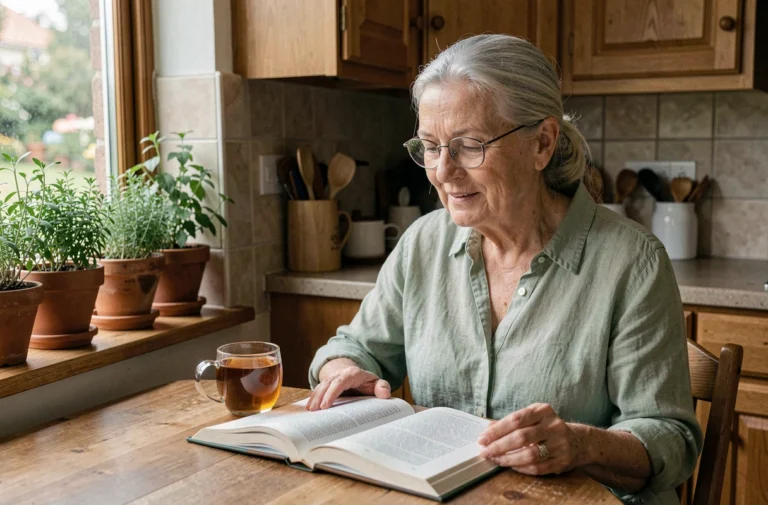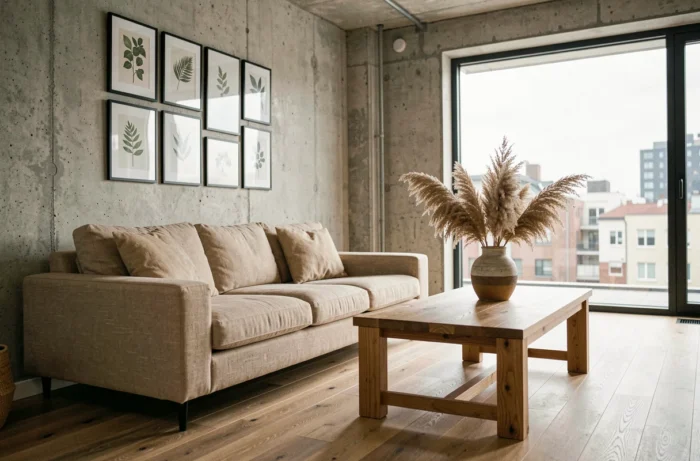
The interior decoration market in France is undergoing a phase of restructuring. The trends observed at the start of the 2026 school year show a gradual shift: uniformly minimalist interiors are giving way to more personalized spaces, where tactile materials and immersive decor are taking on an increasing role. This movement, documented by several specialized press outlets, reflects a need for sensory grounding in the home.
Understanding what is happening behind these changes allows for more sustainable decoration choices, beyond mere fashion trends.
Tactile materials and interior decoration: how the return of the sensory changes things
The most significant trend of this 2026 school year is not about a color or a piece of furniture, but a category of sensations. Several professional sources, including Marie Claire Maison and Le Journal de la Maison, highlight the rise of tactile materials such as brushed wool, suede, mohair, boucle, and velvet. These textiles share a common point: they engage the sense of touch as much as the sense of sight.
This shift alters the way a space is composed. A boucle sofa, a mohair throw, or velvet cushions do not serve the same purpose as a smooth, technical fabric. They introduce visual depth and warmth that strict minimalism tends to erase.
For those looking to refresh their interiors with unique and inspiring decoration, brands like Rêves de Déco offer pieces that fit into this sensory logic, focusing on objects with pronounced textures rather than purely graphic lines.
Field reports diverge on one point: should these materials be concentrated in a single room (the living room, typically) or spread throughout the home? The answer largely depends on the available natural light. A dark room can better support thick, matte materials than a narrow hallway, where they risk weighing down the atmosphere.
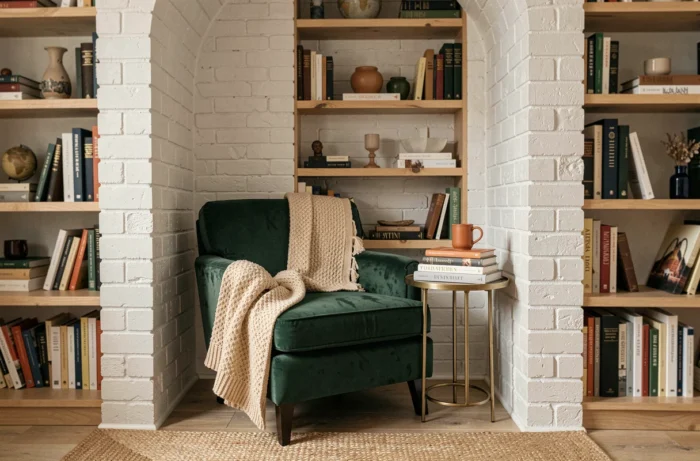
Panoramic wallpaper: a wall decor that redefines space
Panoramic wallpaper is experiencing a marked resurgence in interest in France, as reported by La Voix du Nord in September 2026. Botanical designs and immersive patterns (forests, landscapes, foliage) dominate searches. This is not just a simple return of wallpaper from the 1970s: current panoramics function as full-fledged wall murals.
Their decorative interest is real, but their implementation raises practical questions that inspirational content rarely addresses. A panoramic raises the question of scale: on a wall less than three meters wide, the pattern may appear truncated or squashed. Ceiling height also matters. A vertical forest decor makes sense with a nice height, but loses readability in a low space.
Choosing the right wall for a panoramic
The largest wall is not always the best choice. The wall that first catches the eye when entering the room is often more effective. It is also important to check that the furniture placed in front does not obscure the lower part of the pattern, which frequently happens with a sideboard or a bookshelf.
The available data does not allow for conclusions about the comparative durability of non-woven panoramics and vinyl versions in humid rooms. Manufacturers present contradictory arguments on this point.
Modular furniture: a functional response to reduced spaces
Extendable tables, foldable desks, storage ottomans, reconfigurable storage: modular furniture is gaining ground. According to Déco Maison Guide, this trend responds to a concrete constraint, the reduction of living spaces, and the increasing versatility of rooms (remote work, living-dining room, bedroom-office).
Modular is no longer an aesthetic compromise but a deliberate design choice. Manufacturers now offer refined lines that do not betray their transformable function. A well-designed storage ottoman no longer resembles a student studio piece.
- Extendable tables allow for a transition from daily use (two people) to a meal for six without changing furniture, a plus in modest-sized living rooms.
- Foldable desks tuck away into a closed piece of furniture or against a wall, freeing up space outside of work hours.
- Reconfigurable storage (shelf brackets, stackable cubes) adapts over time without additional purchases.
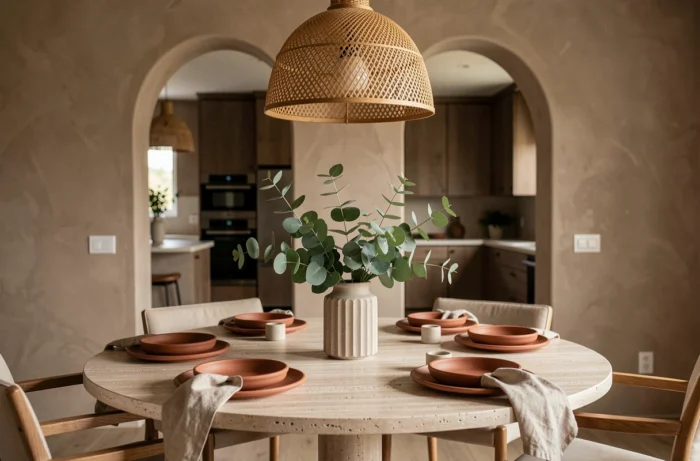
Trending colors for autumn 2026: warm and deep shades
The autumn palettes highlighted by the decor press for 2026 favor warm and deep shades that absorb light rather than reflect it, radically changing the ambiance of a room.
Dark and enveloping tones, in particular, require careful treatment. Applied to all four walls of a living room, a saturated color can create a cave effect. In contrast, used on a single wall or as wainscoting, it adds depth that classic neutrals (gray, beige, off-white) do not produce.
Combining these shades without overwhelming the room
The most common trap is to accumulate dark tones without a light counterpoint. A room entirely treated in deep colors, even with good lighting, risks appearing smaller than it is.
- Alternate a dark wall with light walls (white, linen, sand) to maintain visual breathing space.
- Favor light and powdery tones on ceilings or woodwork rather than on large wall surfaces.
- Test the color with a sample applied directly to the wall, not on a paper swatch, as the natural light in the room significantly alters the appearance.
The question of reuse in decoration also deserves mention. Technical references around the reuse of materials in interior design are gradually being structured, providing a stronger framework for integrating recovered elements (old doors, cement tiles, industrial lighting) into a coherent decorative project.
The decoration trends of this 2026 school year all point in the same direction: an interior that is touched, lived in, and transformed rather than a decor frozen for the photo. The materials, deep colors, and adaptable furniture create a habitat where sensory comfort takes precedence over visual uniformity.