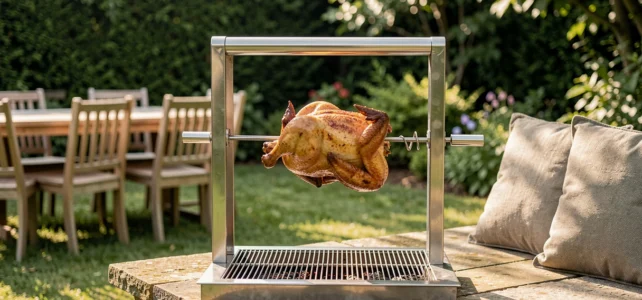
We install the parabolic reflector on the terrace, skewer a chicken, and wait. No charcoal to store, no gas bottle to drag from the garage. The solar rotisserie works with what already falls in the garden: sunlight. For anyone who has ever had to cancel a barbecue due to a fire ban during a heatwave, the device addresses a real practical problem.
Temperatures achieved and types of cooking with the solar rotisserie
The first question that arises in front of a parabolic reflector is: does it really heat enough to sear meat? Current models, like the Sunglobe from Solar Brother, concentrate rays on a focal point and reach up to 250 °C. This is within the range of a classic plancha, sufficient for grilling skewers, roasting a whole chicken, or caramelizing vegetables.
The slow rotation of the spit changes the game compared to a simple solar grill. The regular rotation ensures even cooking without manual turning. You achieve a uniform golden color on a piece of meat without intervention, freeing up time to prepare the rest of the meal.
The efficiency directly depends on sunlight. In overcast skies, the temperature rise slows down, and feedback on this point varies by region and season. In Occitanie or Provence, you can comfortably cook from May to September. In Brittany, the window of opportunity is shorter, and it sometimes takes twice as long to reach the right temperature.
On the recipe side, guides adapted to this slow and radiant cooking are gradually appearing on forums and with specialized manufacturers like Energie O’ Solr innovations, which are more akin to a convection oven than a charcoal barbecue.
Combustion-free barbecue: what it changes in co-ownership and dry areas
Every summer, French municipalities restrict or ban charcoal and wood barbecues in outdoor spaces. The prefectural orders target open flames and embers, not the cooking itself. A solar rotisserie produces neither flame nor smoke, placing it outside the scope of these bans.
In co-ownership, the main problem with traditional barbecues is not the fire, but the smoke. Internal regulations often prohibit charcoal devices on balconies and terraces. The complete absence of combustion eliminates this point of friction with neighbors.
For outdoor catering professionals or event caterers, the regulatory argument carries weight. When organizing a barbecue in a municipal park or on private land during the dry season, not depending on a fire risk-related permit simplifies all logistics.
Usage cost and durability compared to charcoal barbecue
A charcoal barbecue consumes several kilos of fuel per session on average. Over a full season, the charcoal or wood cooking budget accumulates. The solar rotisserie, once purchased, consumes nothing. Zero bags of embers, zero gas refills, zero chemical ignition.
The initial purchase price remains higher than that of an entry-level barbecue. We are talking about an investment comparable to a good gas barbecue. The difference lies in the duration:
- No wear parts related to combustion (charred grill, perforated ash pan, clogged burners)
- The reflector cleans with soapy water, without aggressive chemical products
- No consumables to repurchase, season after season
- No storage of charcoal or gas bottles in the garden or garage
The amortization occurs over two to three seasons of regular use, considering the savings on fuel and the absence of heavy maintenance.
Positioning and adjusting the reflector: common mistakes to avoid
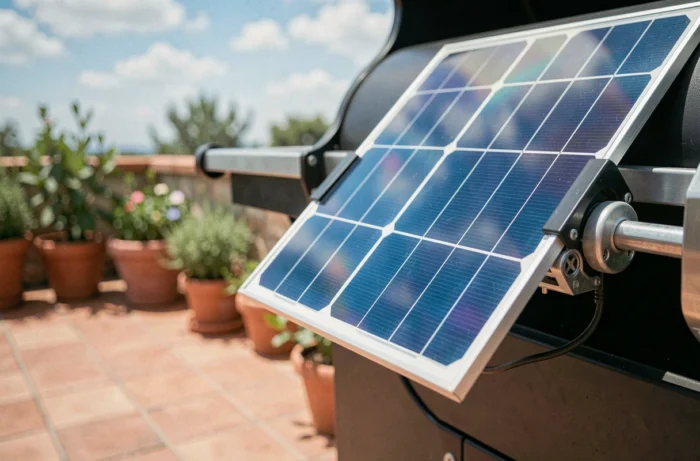
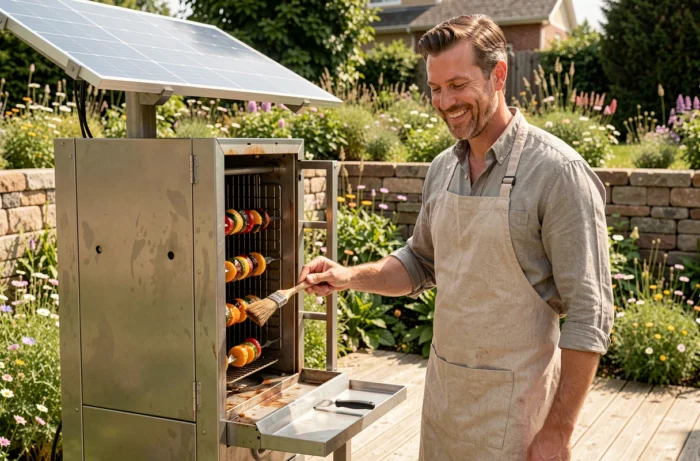
Installing a solar rotisserie is not just about placing it in the sun. The parabolic reflector must be oriented towards the sun at a precise angle, and this angle changes throughout the day. Recent models include a pivoting system that facilitates solar tracking, but you still need to manually intervene every thirty to forty-five minutes to readjust.
The most common mistake: installing the device near a wall or hedge that creates shade in the late afternoon. You should choose an unobstructed location facing south, with no obstacles within three meters. The ground must be stable and flat; otherwise, the focal point shifts, and cooking becomes uneven.
Another often overlooked point: reflection. On a light stone or white concrete terrace, the reflector also captures light reflected from the ground, which accelerates the temperature rise. On grass, you lose a bit of efficiency.
Safety measures to consider around the device
The focal point concentrates intense heat on a very small area. Do not place your hands in the path of the reflector, even briefly. Manufacturers recommend a safety perimeter of about one meter around the device, especially if children are playing in the garden.
Wearing sunglasses is advised when adjusting the orientation, as the light reflection can be dazzling. This is not a gimmick: the reflective surface concentrates enough light to cause rapid visual discomfort.
The solar barbecue in a broader trend of flame-free cooking
The solar rotisserie is part of an underlying movement. According to an analysis by Galaxus published in 2026, the share of electric barbecues in sales has quadrupled in a few years, rising from about 7% to 25% of the market. Flame-free devices are gaining ground, driven by neighborhood constraints, safety standards, and a growing demand for low-consumable products.
Solar takes this logic even further: no electricity either. For a garden without an outdoor socket or for camping, this is a concrete advantage. You depend solely on the weather, which is both the strength and the limitation of the device.
Eco-friendly barbecues are no longer a niche reserved for energy independence enthusiasts. When a solar rotisserie reaches the same temperatures as a gas model and is free from any regulatory constraints related to embers, it becomes a credible option for the summer season, not just a curiosity.