
Every year, schools send families a list of supplies specific to each grade level. At the same time, online platforms offer pre-filled packs designed to simplify shopping. For the 2026 school year, the choice between these two options depends on several concrete factors that families should examine before pulling out their credit card.
New Kindergarten Programs for 2026 and Their Impact on Supply Lists
Competitors rarely address this point, yet it changes the game starting from the first section. The new kindergarten programs for the 2026 school year incorporate age benchmarks and education on emotional and relational life. In practice, this translates into more language activities, symbolic play, and work on emotions.
This orientation modifies the content of school lists. Teachers sometimes request specific materials (extra-wide tip markers, textured papers, sensory activity supports) that do not appear in the standard packs from the platforms. A list tailored to the new programs prevents duplicate purchases.
Parents comparing different ordering options can consult a detailed comparison on maficheclasse com and fr for 2026 to measure the gap between a generic pack and the actual requests from the school.
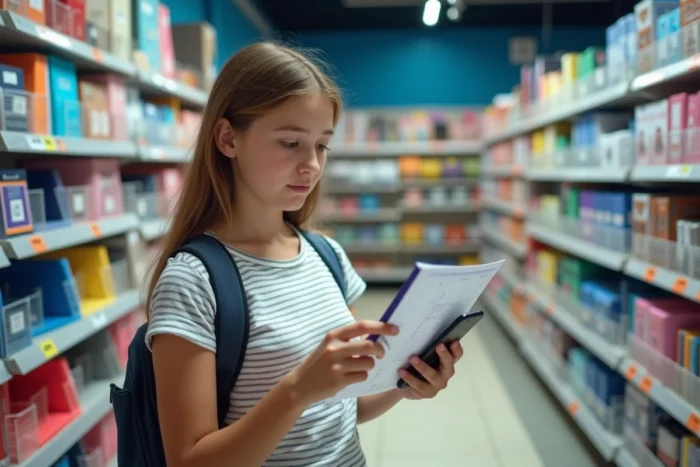
School List: What the Paper Version Guarantees (and What It Complicates)
The list provided by the school remains the reference document. It is written by teachers based on the educational project, the grade level, and sometimes the materials already available in class. Only the school list reflects the exact needs of the teacher.
Concrete Advantages of the Official List
- Each item corresponds to a specific use in class, including imposed brands or formats (notebook 17 x 22, transparent cover without flap, for example)
- Quantities are calibrated for the year, which avoids waste or restocking during the term
- In schools that pool certain supplies, the list specifies what the school purchases collectively and what remains the responsibility of families
The weak point lies in logistics. A paper list requires going through several aisles, comparing references, and sometimes returning to the store when an item is missing. For families with multiple children in different grades, the mental load increases quickly.
School Supply Platform: Time Savings vs. Risk of Approximation
The platforms operate on a simple principle: the family selects the school and grade, then receives a pack containing most of the requested items. The package arrives at home, often with scheduled delivery before the school year starts.
The time savings are real, especially for families far from large stores. No more waiting in line in crowded aisles in August. Some platforms also allow customization of the pack by adding or removing items.
Limitations of Online Packs for the 2026 School Year
The main issue concerns the exact match with the school list. A pack may include a set of notebooks in the wrong format, colored pencils from a different brand than requested, or omit a specific item.
In schools that now include software licenses or access to digital platforms in their lists, supply sites remain focused on traditional physical materials. These digital elements are simply not covered by the packs, which means additional ordering is necessary anyway.
Another point of caution: price. The promise of savings does not always hold true. The cost of the pack includes preparation and delivery. When comparing item by item with prices at supermarkets or stationery stores, the gap can work against the platform, especially during promotional events in July.
Demographic Pressure and Enrollment Management: Why Some Schools Impose Their List
A factor rarely mentioned by buying guides concerns enrollment management. In areas where demographic pressure remains high, schools organize registrations and the start of the school year in a very structured manner. Some institutions explicitly request not to use a platform.
The reason is practical: when a school pools the purchase of certain consumables (glue, paint, paper) through financial contributions from families, the online pack becomes redundant. The child arrives with materials already provided by the school, and the family has paid twice.
In other cases, the school negotiates bulk rates with a local stationery store. Using an external platform then undermines a system designed to reduce the overall bill.
Criteria for Choosing Between Paper List and Platform for the 2026 School Year
The decision depends on the family situation and the school’s operation. A few criteria can help make the choice:
- Check if the school mentions a pooling of supplies or a partnership with a local supplier, in which case the platform becomes counterproductive
- Compare the exact content of the online pack with the official list, item by item, paying attention to formats, weights, and brands
- Evaluate if the list contains digital elements (platform access, license) that only the school can provide
- Consider availability: for families in rural areas or with limited mobility, home delivery remains a tangible advantage despite potential extra costs
The combination of both approaches also works. Order the pack for the bulk of standard materials, then supplement in-store with specific items missing from the package. This method assumes receiving the pack early enough to identify the gaps before the start of school.
The most reliable reflex remains to contact the school as soon as the list is published. A quick exchange with the teacher or principal allows knowing if an online pack will cover the needs or if it is better to stick to the list, line by line.