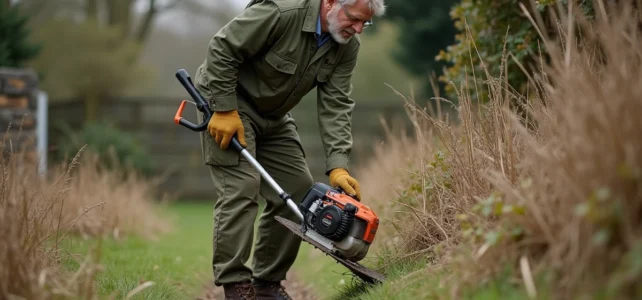
The market for thermal brush cutters is increasingly segmented between classic 2-stroke models and low-emission 4-stroke engines. Choosing the best thermal brush cutter for your garden is not just about comparing the engine displacements listed on product sheets. The configuration of the terrain, the type of vegetation to be managed, and the ability to maintain the machine over the long term weigh as heavily as the engine’s raw power.
Availability of spare parts and after-sales service network: the criterion that no one compares
Classic buying guides align engine displacements, weight, and cutting systems. They overlook a factor that significantly impacts the total cost: the duration of availability of spare parts and the existence of a local repair network.
A widely distributed brand thermal brush cutter (Stihl, Husqvarna, Echo, Honda) generally offers access to cutting heads, starters, housings, and harnesses for eight to ten years after purchase. Less well-known brands, often positioned at attractive entry-level prices, do not guarantee this support. The cost difference over the lifespan can make a discount model much more expensive than a professional model.
Before finalizing a purchase, check if an authorized dealer or an independent repairer covers your geographical area. A thermal engine requires regular maintenance (air filter, spark plug, carburetor), and with a model whose parts are unavailable after three years, the machine ends up in the landfill. To compare the available ranges and their technical characteristics, resources like top-debroussailleuse-thermique.com allow you to cross-reference the models before heading to the store.
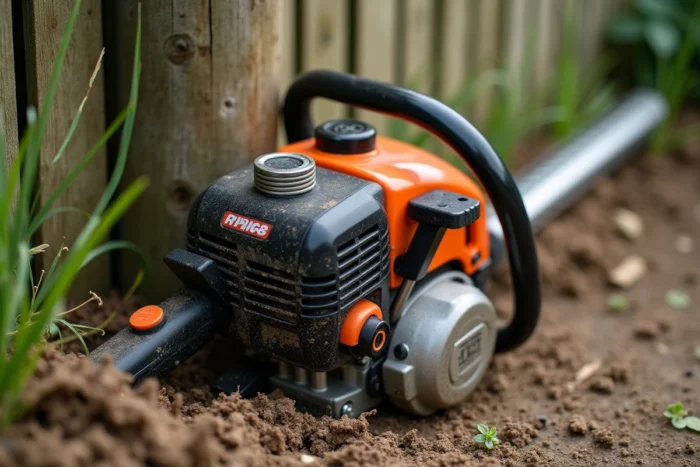
Thermal brush cutter on sloped terrain: weight, harness, and center of gravity
Engine displacement alone is not enough to determine the right model when the garden has a significant slope. Recent feedback shows that on steep terrain, three parameters take precedence over engine power.
- The weight of the machine, which affects fatigue during work sessions exceeding half an hour. A model that is too heavy destabilizes the user when going downhill and excessively strains the lower back when going uphill.
- The harness: a double model with adjustable straps distributes the load across both shoulders and the hips. A simple single-strap harness, often provided as standard on entry-level models, concentrates the effort on one side of the body.
- The center of gravity of the machine must remain low and close to the body to limit lateral swinging. This criterion depends on the position of the engine and the length of the shaft, two factors rarely highlighted in comparisons.
On a slope, a medium displacement model equipped with a good double harness will be more effective and less dangerous than a large displacement model poorly strapped. Testing the harnessed machine in-store, or at least checking the type of harness provided, avoids unpleasant surprises during use.
2-stroke or 4-stroke engine: noise standards and local constraints
The distinction between 2-stroke and 4-stroke engines goes beyond the issue of oil-gasoline mixing. Several municipalities and intercommunalities in France have begun to restrict the use of 2-stroke engines deemed too noisy for private individuals. These restrictions are based on noise nuisance decrees and territorial climate-air-energy plans.
4-stroke brush cutters emit less noise and release fewer pollutants, making them compatible with the strictest local regulations. Their operation on pure gasoline (without mixing) also simplifies fuel preparation.
However, 4-stroke engines are heavier at equal displacement, and their low-end torque differs. For thick brambles or woody undergrowth, a higher displacement 2-stroke retains an advantage in responsiveness. Field feedback on this point varies depending on vegetation density and each user’s cutting habits.
Thermal-battery equivalence: a useful reference
Recent data establish a performance equivalence between a thermal brush cutter of about 30 cm³ and a 36-40 V brushless battery model. This correspondence, rarely specified in general guides that still simply oppose “thermal = powerful / battery = light,” helps to identify the threshold beyond which thermal remains unmatched by electric for heavy-duty work.
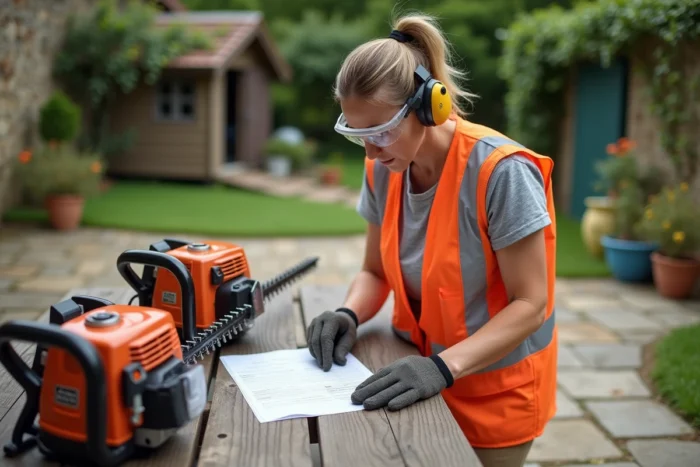
Cutting system: line, blade, or disc depending on the vegetation
The choice of cutting system determines what the brush cutter can actually cut. Three families cover almost all garden situations.
The nylon line head is suitable for tall grass and finishing along edges. It wears out quickly on woody stems and thick brambles. On this type of vegetation, the line head strains the engine, increases consumption, and produces an uneven cut.
The blade or steel disc head tackles brambles, young shrub shoots, and semi-woody undergrowth. It requires more caution (debris projection) and appropriate protective equipment: visor, leg guards, cut-resistant gloves.
Tungsten discs, rarer and more expensive, are intended for intensive brush clearing work on thick vegetation. Their lifespan partially offsets the initial extra cost, but they are not suitable for finishing work.
No single cutting system covers all the needs of a varied garden. Most mid-range and high-end thermal brush cutters accept multiple interchangeable head types. Checking the compatibility of accessories before purchase avoids the need to buy a second machine.
Choosing a thermal brush cutter should be approached as an investment over eight to ten years, not as a one-time purchase. The power of the engine attracts attention, but it is the combination of after-sales support, adaptation to the terrain’s relief, and the versatility of the cutting system that separates a reliable tool from a machine that gathers dust in the garage after two seasons.