
On a pedestrian slab construction site, concrete is often measured with a shovel, counting the scoops “approximately.” Three weeks later, the first cracks appear. The problem almost never comes from the cement itself, but from the ratio between the components and especially from the amount of water poured into the concrete mixer.
Water/cement ratio: the real gauge for concrete dosage for a slab
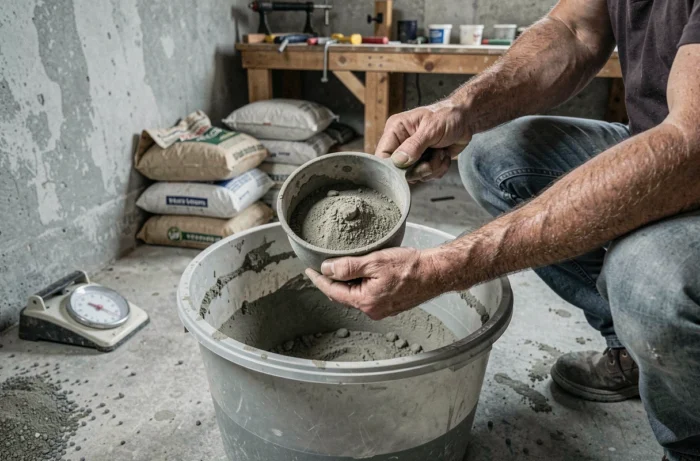
There is a lot of talk about the proportions of cement-sand-gravel, but the parameter that determines the final strength is the water/cement ratio (noted E/C). For an outdoor slab exposed to frost, this ratio must remain below 0.55. In practical terms, this means that for 35 kg of cement, one should not exceed 17 to 18 liters of water.
Just one extra bucket of water can halve the strength of the concrete. Excess water creates pores in the hardened mass, which become points of weakness against freeze-thaw cycles or repeated loads.
On site, there is a strong temptation to add water to make the mix more fluid and easier to screed. This improves pouring comfort, but it reduces durability. The right approach is to measure the water with a graduated bucket, not to pour it from a hose.
This rigor regarding the E/C ratio does more for the durability of a slab than the choice between CEM I or CEM II cement, a topic on which feedback varies according to suppliers and regions.
To delve deeper into this point and other common formulation errors, one can consult the concrete advice on News Connect that detail the common pitfalls during mixing.
Concrete dosage 350 kg/m³ and strength class C25/30: linking the two
Most guides recommend a dosage of 350 kg of cement per cubic meter for a slab. This figure is not arbitrary: it corresponds to the common formulation to achieve a strength class C25/30, measured on a specimen at 28 days. This class is suitable for house slabs, terraces, and pedestrian walkways.
Thinking in terms of strength class rather than “number of bags” changes the logic. One is no longer trying to put in “enough cement,” but rather to achieve measurable and verifiable performance. The NF EN 206 standard governs these classes and sets limits on the E/C ratio according to the exposure environment.
What this changes in practice on site
For a homeowner pouring their own slab, aiming for C25/30 means adhering to three simultaneous constraints: a dosage around 350 kg/m³, an E/C ratio below 0.55, and a clean aggregate, free of dirt or clay. If the sand is wet (which is common in outdoor storage), it already contains water that must be deducted from the amount poured into the concrete mixer.
Many cracked slabs do not have a cement dosage problem. They have an issue with dirty sand or gravel that is too fine, which alters the grain size of the mix without one realizing it.
Field proportions: the 1-2-3 rule and its limits
The classic rule of “1 volume of cement, 2 of sand, 3 of gravel” remains a good starting point. For a 35 kg bag, this gives about 5 buckets of sand, 7 buckets of gravel, and 17 to 18 liters of water. With a standard concrete mixer, one obtains around 100 liters of fresh concrete per batch.
- Check the moisture of the sand before each batch: wet sand already contains several liters of water per bucket, which skews the dosage if one does not reduce the input from the hose.
- Use appropriately sized gravel (often 5/20 for a standard slab): gravel that is too fine requires more cement for the same strength.
- Measure the water with a graduated bucket, never from the hose: precision on the water matters more than precision on the gravel.
- Plan for a margin of about 10% on the total calculated volume to absorb losses, local over-thicknesses, and concrete that remains stuck in the mixer.
This 1-2-3 rule works well for a standard pedestrian slab. For a vehicle-accessible slab, one sometimes increases the cement dosage or switches to ready-mixed concrete delivered by a truck, whose formulation is controlled at the plant.
Slab thickness and concrete volume: the calculation that is often rushed
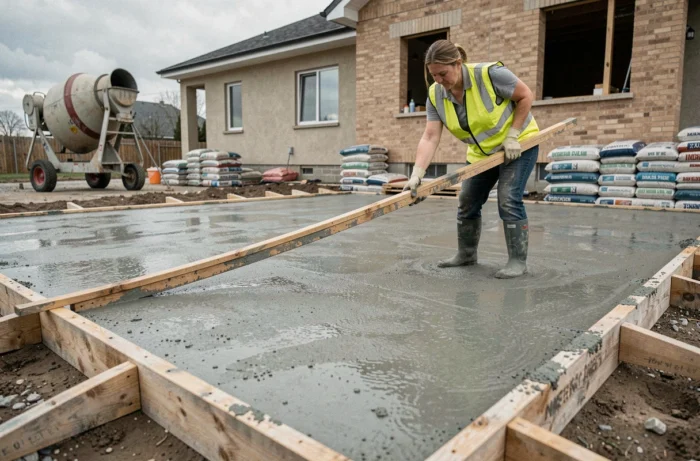
Even before discussing dosage, one must calculate the exact volume to pour. Length x width x thickness in meters gives the volume in cubic meters. An error of a few centimeters in thickness, repeated over the entire surface, can represent several tens of liters of concrete more or less.
It is often seen that slabs intended to be a certain thickness end up thinner in the corners because the formwork was not level. The result: an irregular thickness that creates weak zones where the concrete is thinnest.
Prepare the formwork before calculating the volume
Compact the formwork and check its flatness with a laser level or a mason’s rule to achieve a consistent thickness. The planned volume is then poured without unpleasant surprises. This is a groundwork task that should be done before ordering materials, not after.
- Excavate to the planned depth and compact in successive passes with a vibrating plate.
- Check the flatness at several points: a difference of a few centimeters on the bottom translates to the finished thickness.
- Lay a polyethylene film if the ground is clayey to prevent moisture from rising, which weakens the underside of the slab.
Pouring and curing concrete: two steps where dosage is useless if poorly protected
Perfectly dosed concrete can still crack if pouring and curing are neglected. Pouring in hot weather without protecting the surface accelerates evaporation and causes plastic shrinkage, those micro-cracks that appear in the first hours.
After pouring, the surface must remain moist for several days. One can use a tarp, a curing product sprayed on, or simply lightly water the slab morning and evening. Without this step, the cement does not have enough water to complete its setting, and the final strength remains below what the dosage could have achieved.
The dosage of concrete for a slab is not just a matter of proportions in the mixer. It is a chain of decisions that goes from the choice of sand to the protection of the slab in the days following the pour. Missing one link, even with a perfect dosage of 350 kg/m³, is enough to compromise the result.