We sleep for six hours and wake up tired. We sleep for nine hours, same result. The problem rarely comes from the number of hours displayed on the alarm clock, but from what happens during those hours. Understanding how many hours of sleep correspond to your actual needs requires looking beyond the single figure hammered everywhere.
Sleep duration after 65: why the range changes
American recommendations (CDC/AASM) now distinguish three subgroups of adults instead of one single block of “7 to 9 hours.” For those aged 18-60, the range remains broad. For those aged 61-64, there is a slight tightening. For those aged 65 and older, the recommended range drops to 7-8 hours per night.
This recalibration is not trivial. Deep sleep naturally decreases with age, nighttime awakenings multiply, and the circadian rhythm advances: we fall asleep earlier and wake up earlier. Aiming for eight hours in bed when part of that time is spent awake confuses time spent lying down with actual sleep time.
For seniors, the question of how many hours of sleep are needed for good health is posed differently: it’s better to have seven continuous hours than eight hours fragmented by three prolonged awakenings.
A short nap (twenty to thirty minutes in the early afternoon) can compensate for a nighttime deficit without disrupting evening sleep onset. Beyond this duration, one risks further shifting the cycle.
Oversleeping is harmful too: the J-shaped curve of health risks
Much is said about the dangers of lack of sleep. Less is mentioned about excess. Recent syntheses, including one published in JAMA Network Open and referenced in a Chinese note from August 2026, confirm a J-shaped relationship between sleep duration and health risks.
Specifically, both too short and too long durations are associated with more cardiovascular, metabolic, and cognitive problems. The low point of the curve, where risks are lowest, is around seven hours for the majority of adults.
Regularly sleeping more than nine hours may signal an underlying disorder (sleep apnea, depression, inflammatory condition) rather than a simple high physiological need. If one consistently wakes up tired after nine hours of sleep, the avenue to explore is not “sleep more,” but “sleep better.”
Signals to monitor daily
- Marked drowsiness in the early afternoon despite a night of more than eight hours, which may indicate fragmented sleep or undiagnosed apnea
- Needing more than twenty minutes to fall asleep each night, a common sign of a mismatch between bedtime and actual circadian rhythm
- Repeated nighttime awakenings with difficulty falling back asleep, often linked to stress or an unsuitable environment (light, noise, temperature)
- Persistent fatigue upon waking despite a night duration deemed sufficient
Sleep quality: cycles matter more than hours
A sleep cycle lasts on average 90 minutes and includes several phases: light sleep, deep sleep, REM sleep. A complete night chains four to six cycles. Waking up between two cycles provides a significantly greater sense of rest than waking up in the middle of deep sleep, even if the total duration is shorter.
This logic can be tested simply. Instead of setting the alarm for exactly eight hours, calculate multiples of 90 minutes from the estimated sleep onset time. Six hours (four cycles) or seven and a half hours (five cycles) often correspond better than seven hours, which falls in the middle of a cycle.
What degrades quality without reducing duration
Alcohol is a classic case. One falls asleep quickly, but REM sleep is cut short in the second half of the night. The result: eight hours on the clock, the recovery of a five-hour night.
Screens before bed significantly delay melatonin secretion. The time to fall asleep lengthens, the first cycle of deep sleep is pushed back, and the night starts already in deficit.
The temperature of the room also plays a measurable role. An environment that is too warm (above 19-20 degrees) causes micro-awakenings that one does not consciously perceive but that fragment the cycles.
Identifying your real sleep need without a tracker
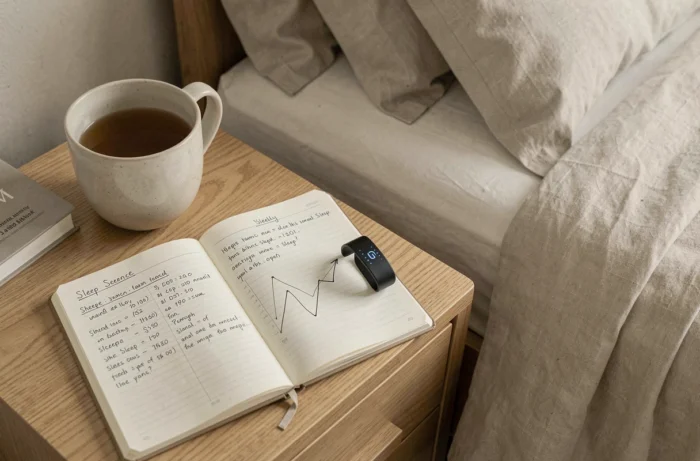
Fitness bands and smartwatches provide interesting data, but their reliability in detecting sleep phases remains questionable. Feedback varies greatly from one model to another on this point.
The most reliable method remains observation during a vacation or extended rest period, without the constraint of an alarm. After a few days of recovering accumulated sleep debt, the body naturally stabilizes on its adapted sleep duration. Note the time of spontaneous sleep onset and the time of natural awakening over a week: the average provides a solid benchmark.
- During the first three days, ignore the observed durations as the body repays its sleep debt
- From the fourth day, note the felt bedtime (when drowsiness arrives) and the time of spontaneous awakening
- Calculate the average over four to five consecutive nights to obtain your actual physiological need
This approach works better than an online questionnaire because it measures actual behavior, not a declarative estimate. A “short sleeper” needs less than six hours and feels fine. A “long sleeper” needs more than nine hours. The majority of adults fall between seven and eight hours, but comparing oneself to an average makes no sense if your genetics place you elsewhere.
The only criterion that ultimately matters: the alertness and energy felt in the hours following awakening. If they remain stable throughout the day, the nighttime duration is right, regardless of the number.