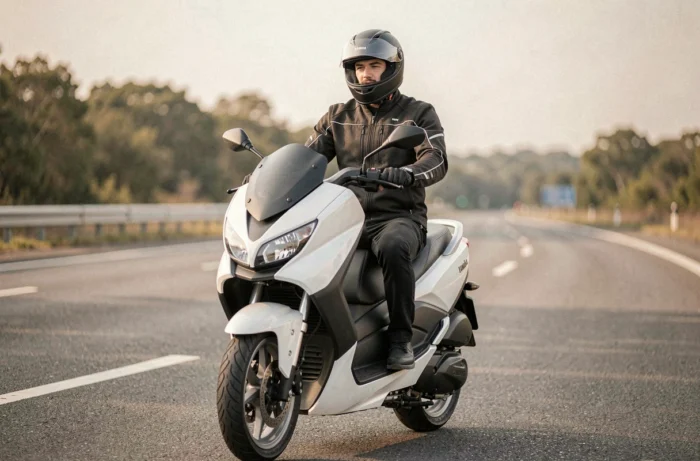
The Yamaha Xmax 125 model year 2026, certified Euro 5+ with Start & Stop, is powered by the same Blue Core single-cylinder engine producing 12.23 hp and 11.2 Nm as the previous generation. The manufacturer’s figures haven’t changed, but real-world measurement conditions tell a different story. Understanding the maximum speed of this GT scooter requires distinguishing three data points: the speedometer reading, the GPS value, and the usable speed in real situations.
Variator Limit and Power Curve: What Caps the Xmax 125
The Blue Core engine reaches its peak power in the last few thousand RPMs. On a scooter with CVT transmission, the top speed depends on when the variator hits its limit, with rollers pressed against the outer wall of the movable face.
On the 2026 Xmax 125, this mechanical stop coincides with an engine speed already close to the rev limiter. The result: no acceleration reserve once cruising speed is reached. The RPM remains fixed, as does the gear ratio. Any variation in resistance (wind, incline, weight) directly translates into a loss of speed, with no possibility of compensation.
We observed in several GPS tests that the maximum speed of the Xmax 125 fluctuates between 105 and 108 km/h in real conditions, while the speedometer shows 116 to 118 km/h. The discrepancy, consistent across this type of engine, comes from regulatory tolerance that allows the manufacturer to display a value higher than the actual speed.
This mechanical ceiling has a direct consequence in road use: overtaking a vehicle traveling at 100 km/h on a fast lane becomes a lengthy maneuver, with only a few km/h margin. The issue is not the displayed speed; it’s the complete lack of exploitable surplus.
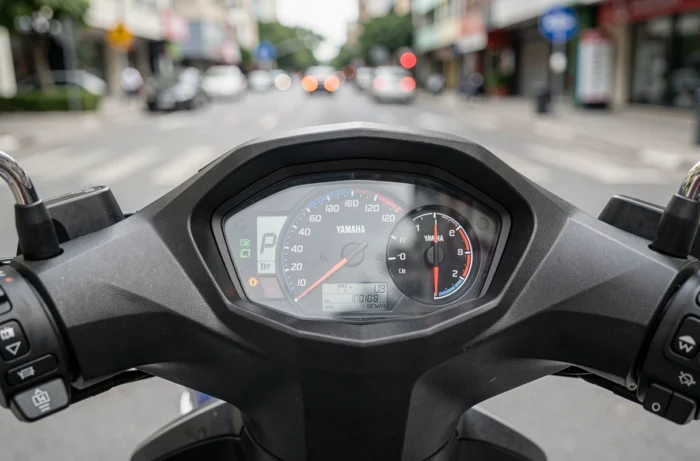
Speedometer-GPS Discrepancy on the Xmax 125: Calibration and Legal Tolerance
European regulations require that a speedometer never underestimates actual speed. In practice, manufacturers apply a safety margin that inflates the display by 8 to 12% depending on the model.
On the 2026 Xmax 125, GPS readings published by independent testers show an average discrepancy of about 10 km/h between the speedometer and GPS at top speed. This offset remains stable regardless of speed, indicating a linear calibration rather than a progressive bias.
For daily use, this discrepancy changes the perception of the legal margin. A driver who sets their speedometer to 118 km/h on a road limited to 110 km/h is actually traveling around 108 km/h GPS. The comfort margin exists, but it is slim. With a passenger or a crosswind, this GPS value can drop below 105 km/h.
Factors that Increase the Discrepancy
- The rider’s weight affects the variator’s behavior: a rider over 85 kg reduces the GPS top speed by a few km/h, without the speedometer accurately reflecting this loss.
- Tire pressure influences the effective rolling diameter: an under-inflated tire by 0.3 bar skews both the speedometer reading and fuel consumption.
- Wear on the variator rollers, after several thousand kilometers, shifts the stop point and can gradually reduce the maximum speed without obvious symptoms.
Start & Stop and Real Consumption: The Angle Not Shown in the Technical Sheet
Yamaha claims 2.3 L/100 km with Start & Stop activated versus 2.4 L/100 km without. The difference may seem trivial, but it becomes significant when related to the 13.2-liter tank and the theoretical range stated to exceed 500 km.
In practice, Start & Stop does not affect top speed. Its benefit is concentrated in urban and suburban phases, where frequent stops accumulate wasted fuel at idle. We observe that this system primarily alters the operating cost on short trips with many traffic lights, not the behavior at high speed.
The actual range heavily depends on the driving profile. Exclusively suburban use, with few full-throttle phases, allows approaching the manufacturer’s figures. Mixed use including stretches of fast road at high constant RPM significantly increases consumption.
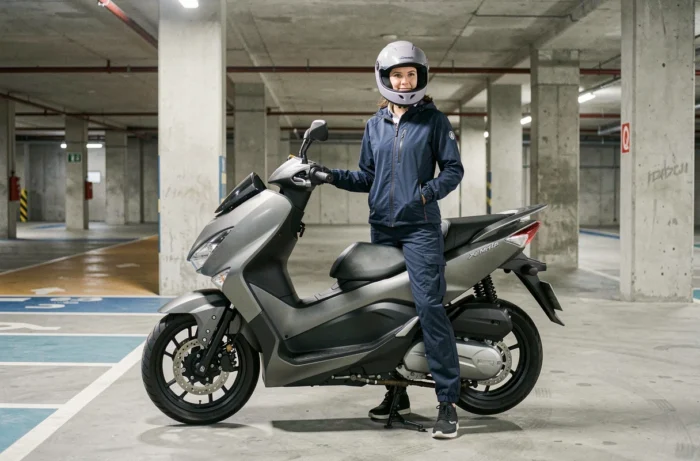
High-Speed Stability: ABS, Traction Control, and Chassis of the Xmax 125
Riding at 105-108 km/h on a 167 kg scooter fully fueled requires a chassis capable of handling aerodynamic turbulence and surface irregularities. The 2026 Xmax 125 comes equipped with ABS and traction control as standard, two features that change behavior in emergency braking situations or loss of grip on wet pavement.
The adjustable windshield modifies the aerodynamic pressure on the rider’s torso. In the high position, protection increases but so do lateral turbulence, especially above 100 km/h on the speedometer. In the low position, the airflow hits the helmet directly, causing fatigue on long trips.
Equipment Influencing High-Speed Use
- Heated grips and a heated seat, available on the Tech Max+ version, reduce muscle tension in cold weather, improving riding precision at high speeds.
- The Smart Key eliminates the physical manipulation of the ignition lock, an ergonomic detail that doesn’t affect speed but smooths daily use.
- The contained weight (167 kg) enhances maneuverability in the city but limits the gyroscopic stabilizing effect on fast roads compared to a maxi-scooter with a larger engine displacement.
The Xmax 125 2026 remains a GT scooter designed for suburban and mixed trips. Its real GPS speed between 105 and 108 km/h is sufficient for traveling on fast lanes within traffic flow, but with no margin for quick overtaking. The price of 6,599 euros for the Tech Max+ version positions this model at the level of a mid-range motorcycle, a positioning justified by the onboard equipment, not by raw performance.