
How much does a sales associate or department manager at H&M actually earn in France? Between the minimum wage that serves as the baseline for most store positions and successive legal increases, compensation at the Swedish retailer depends on mechanisms that are often misunderstood. This article measures salary disparities by position, details the concrete impact of minimum wage increases on paychecks, and reviews employee benefits that complement gross compensation.
Minimum Wage and Salary at H&M: The Legal Floor That Sets Everything
At H&M France, the majority of store positions (entry-level sales associate, cashier, part-time sales advisor) are paid at or slightly above the minimum wage. This point is structural: each increase in the minimum wage directly affects these contracts, without the retailer needing to negotiate anything internally.
As of November 1, 2024, the gross hourly minimum wage increased to €11.88, representing a 2% rise. Then, on January 1, 2026, it was raised to €12.02 gross per hour, with a further increase of 1.2%. For a full-time contract, this represents a minimum gross monthly salary that has increased twice in just over a year.
A detailed guide on salary at H&M helps to better contextualize these amounts against the realities on the ground in stores.
This mechanism has a direct consequence: an H&M employee paid at the legal minimum at the end of 2023 saw their hourly wage automatically increase, without individual negotiation or company agreement. In contrast, for employees whose pay already exceeded the minimum wage, there is no legal obligation for H&M to increase it by the same proportions. The risk of wage compression between entry-level and more experienced employees is real.

H&M Salary Grid by Position: Comparative Table
The salary gaps between an entry-level position and a supervisory role in the store are not negligible, even if the overall range remains modest compared to other sectors.
| Position | Current Status | Salary Level |
|---|---|---|
| Sales Associate / Sales Advisor | Employee, often part-time | Minimum wage or very close |
| Cashier | Employee | Minimum wage |
| Visual Merchandiser | Employee or supervisory agent | Slightly above minimum wage |
| Department Manager | Supervisory Agent | Well above minimum wage |
| Store Manager | Executive | Retail executive salary |
The majority of the workforce is concentrated in the first two lines. Moving to the position of department manager represents the first real salary progression milestone. Conversely, the positions of sales associate and cashier remain very close to the legal minimum, which explains why increases in the minimum wage have such a direct impact on the payroll in stores.
Working Hours and Contracts: What Affects Net Salary
Gross salary tells only part of the story. At H&M, a significant proportion of the contracts offered in stores are part-time, often between 20 and 30 hours per week. For a sales associate at minimum wage, the difference between a 24-hour contract and a 35-hour contract translates into a gap of several hundred euros net per month.
Several factors directly influence the payslip:
- The volume of contractual hours, which varies according to the store’s needs and the period (peak times during sales, holiday season)
- Evening or Sunday work, which may lead to bonuses according to the applicable collective agreement
- The duration of the contract (seasonal fixed-term, part-time permanent, full-time permanent), each format having its own rules regarding the probationary period and vacation rights
- Complementary hours, regulated by labor law and subject to bonuses beyond a certain threshold
For a part-time employee, the net monthly salary often hovers around the prorated minimum wage, which places the actual compensation well below what a full-time position suggests. H&M’s recruitment ads rarely mention this detail explicitly.
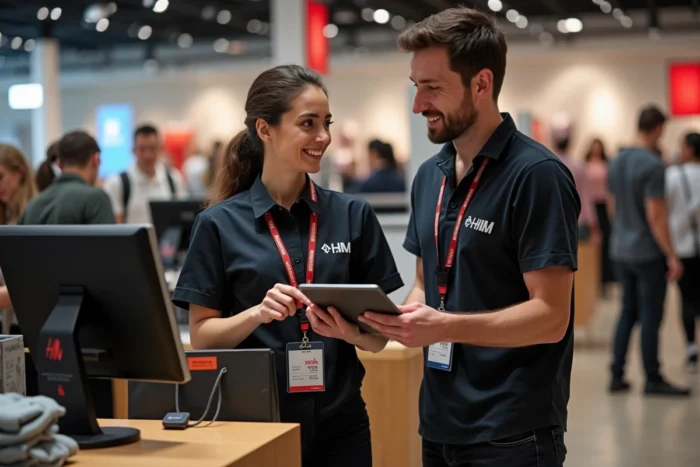
H&M Employee Benefits: Beyond Gross Salary
Compensation at H&M is not limited to the salary paid each month. The retailer offers a range of benefits that partially offset the entry-level pay.
The most visible is the employee discount on in-store purchases. This program, common in retail, allows employees to buy collections at reduced prices. For younger or student profiles, this benefit has real practical value.
In addition to this discount, employees benefit from standard legal provisions: company health insurance (mandatory), transportation cost participation, paid leave according to labor law. The applicable collective agreement specifies the rules regarding weekly rest, worked holidays, and potential bonuses.
Career Progression and Its Effect on Compensation
H&M promotes internal advancement as a loyalty lever. Moving from sales associate to department manager represents the most significant salary jump accessible without additional qualifications. This path typically takes several years and depends on the size of the store, vacant positions, and internal evaluations.
Thus, salaries at H&M remain largely indexed to the minimum wage for store positions, with two progression levers: moving to full-time and accessing a supervisory position. Legal increases in the minimum wage remain the primary driver of salary increases for the majority of employees, while additional benefits slightly soften the equation without fundamentally changing the level of compensation.