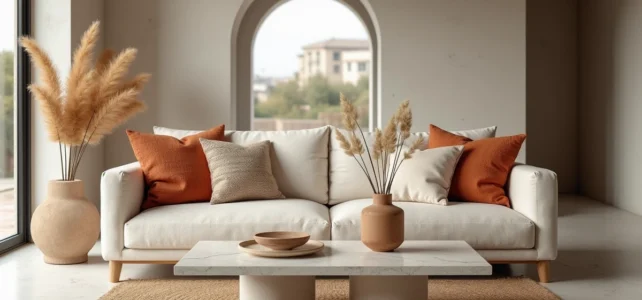
The decor trends of 2026 are no longer limited to a dominant palette or style. The value of an interior is now measured by the traceability of its materials, their maintenance capacity, and the coherence between living space and object density. We are observing a clear shift: decor becomes a system where every piece of furniture, every covering, every accessory must justify its presence through its durability or actual use.
Textured surfaces and durable coverings: the true foundation of a trendy interior
The choice of covering conditions the entire perception of a room, much more than furniture or accessories. In 2026, textured surfaces replace smooth and uniform finishes, not only for their visual appeal but because they age better and hide everyday micro-scratches.
Material effects (reconstituted stone, waxed concrete, textured stoneware) are gaining ground in living rooms as well as kitchens. Their longevity and ease of maintenance make them a more rational investment than paint that needs to be renewed every three years.
We recommend treating wall or floor coverings as the first decor decision, not the last. A textured stoneware floor in a terracotta tone imposes a clear chromatic direction for the rest of the room. Starting with the covering avoids the classic pitfall: accumulating trendy furniture that does not communicate with each other.
To delve deeper into this type of reflection on the overall coherence of a space, Parlons Déco’s decor inspirations offer concrete approaches that go beyond a simple product catalog.
2026 Palette: working by family of shades, not by a single color
The color of the year is no longer an isolated hue but a family of natural shades. Bright white, deep blue-green, soft earth tones: these tones work together and allow for the composition of an interior without visual breaks between the rooms.
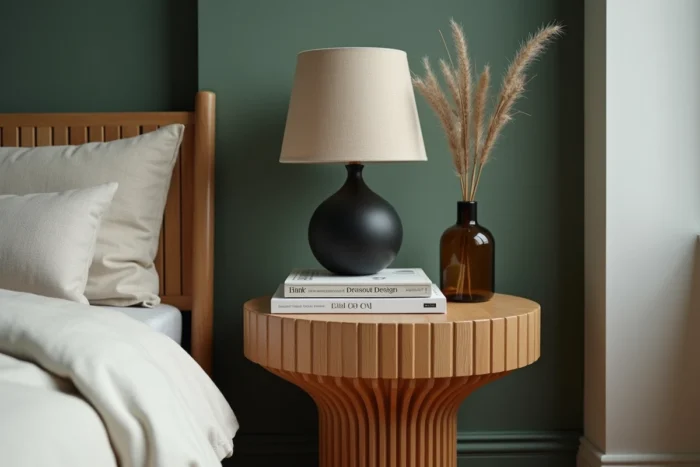
This family approach resolves a common problem in small spaces. When the area is limited, multiplying bold colors visually fragments the room. Working with a single family of shades (for example, three variations of earth, from light sand to deep clay) unifies the open living room and kitchen without monotony.
Warm colors – clays, ochres, terracottas – dominate residential projects this year. Deep blues and greens work more as accents: an armchair, a wall section, a striking vase. Not as a total flat.
Common mistake about trendy colors
Applying the Pantone color of the year to an entire wall without considering the light exposure almost always produces a disappointing result. A deep blue-green hue in a north-facing room will appear dull and cold. Testing the color on a wall section exposed to direct natural light remains the only reliable method before committing.
Decoration in small spaces: the logic of subtraction rather than addition
The “less is more” trend in 2026 is not a minimalist slogan. It is an operational method for apartments where every square meter counts. The principle: every decorative object removed visually enlarges the space more than adding a clever piece of furniture.
The concrete levers that work in a small interior:
- Light colors on the walls and ceiling to visually push back the limits of the room, combined with one or two warm accents in accessories
- Vertical storage (wall shelves, narrow columns) that frees up the floor and clears circulation
- Light furniture, with visible legs, that allows light to pass at floor level and lightens the perception of volume
- Strict limitation of decorative accessories: three well-chosen objects on a shelf are better than twelve accumulated trinkets
Natural light remains the best ally of a small space. Before investing in compact furniture, checking that nothing obstructs the windows (thick curtains, tall furniture placed in front of openings) often produces an immediate and free visual gain.
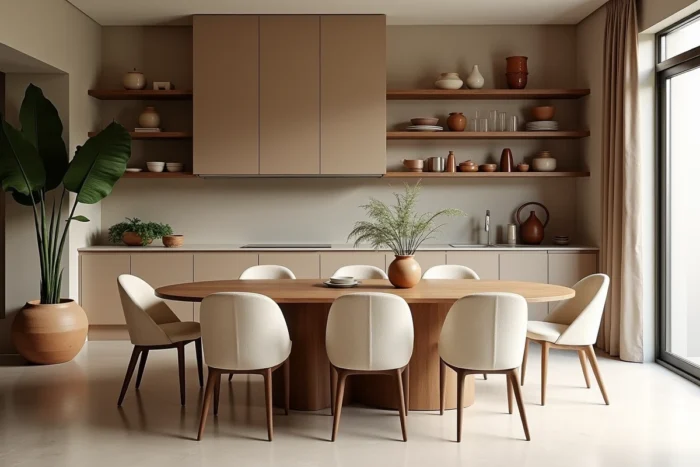
Traceable and repairable materials: the game-changing decor criterion
The most structuring evolution in interior decoration this year concerns the origin and reparability of materials. The history of a piece of furniture (wood from where, assembled how, repairable or not) becomes a selection criterion on par with its shape or color.
This requirement reshapes the hierarchy of materials. A solid wood piece that can be sanded down and have its fittings replaced retains its decorative value for decades. A piece made of melamine board, even perfectly trendy, loses all appeal at the first chip.
What this changes for choosing living room furniture
We are observing a marked return to artisanal finishes and pieces where the manufacturing time is reflected in the details: visible joints, slightly irregular surfaces, natural patinas. This is not nostalgia. A repairable piece of furniture costs less over ten years than a disposable piece replaced three times.
Concretely, for a living room, this means investing more in the coffee table and sofa (the two most used pieces) and accepting more modest accessories around. Better to have a removable and reupholsterable fabric sofa than a trendy model whose cover cannot be changed.
Avoiding the catalog effect: choosing a unique guiding thread
The most frequent trap when following decor trends is to add elements from several unrelated universes. The result: an interior that resembles a magazine page flipped through too quickly.
The most effective method relies on choosing a single guiding thread from these options:
- A dominant material (dark wood, linen, natural stone) applied to at least three elements of the room
- A chromatic family applied from the floor to the textiles, with variations in value rather than hue
- A specific era or craft movement (70s, Scandinavian craftsmanship, Japanese ceramics) limited to a few strong pieces
A coherent interior relies on a single repeated choice, not on five overlapping trends. Style is built through subtraction, by removing what does not serve the chosen guiding thread, rather than by accumulating attractive objects taken in isolation.
Furniture, colors, coverings, and accessories form a system. When this system works, the interior gives an impression of correctness that depends neither on the budget nor on the available space.