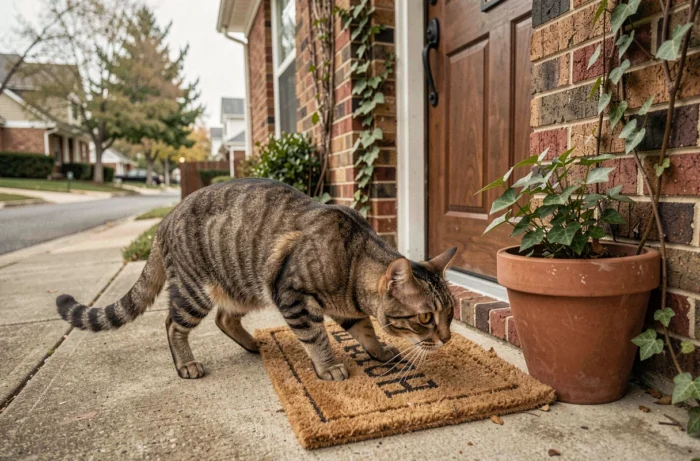
A cat you have never seen pushes the door of your garden, settles on your terrace, or meows in front of your window. The scene repeats itself for several days in a row. Understanding what motivates this behavior requires considering several factors: territory, the animal’s condition, local context, and even legal framework.
Feline wandering and legal framework: what the Rural Code says
Before seeking behavioral explanations, a legal point deserves to be made. The Rural Code defines a state of wandering for cats based on their identification. A non-identified cat must not stray more than 200 meters from its home. A cat with a microchip or tattoo can go up to one kilometer before being legally considered as wandering.
This threshold has a direct consequence: if the cat that comes to your home bears no signs of identification and its home is beyond 200 meters, its owner is liable for any damages. To explore the reasons for a cat’s visit in detail, it is therefore necessary to distinguish between the neighbor’s cat on a stroll and a truly stray or abandoned cat.
This distinction changes everything in the response to be provided. An identified cat that crosses your threshold falls under a neighborhood situation. A cat without a microchip or tattoo may potentially require reporting to the town hall or a veterinarian.
Increase in cat abandonments: a context that weighs on neighborhoods
The likelihood of seeing an unknown cat settle in your home is not constant. It depends on the number of homeless animals in your area. Recent data from the SPA sheds light on this trend.
In the summer of 2026, the SPA rescued 9,508 animals, including 6,572 cats, representing an increase of about 20% in cat abandonments in one year compared to 2025. This record means that a growing volume of cats is roaming without attachment, seeking food, shelter, and human contact.
An abandoned cat does not immediately lose its domestic instincts. It seeks an environment that resembles what it knows: a heated home, regular human presence, a predictable food source. Your home may check these boxes better than the nearest shelter.
Differentiating an abandoned cat from an exploring cat
The signs are not always obvious, but a few observations help to make a decision:
- A thin cat with dull fur or showing eye discharge has likely lived for several weeks without care. This is not just a simple visit of curiosity.
- A clean, well-fed cat that comes at fixed times and then leaves likely belongs to a neighboring household. Its roaming territory includes your garden.
- A cat that persistently meows at your door, especially at night or in cold weather, expresses a need for shelter or food. This vocal behavior directed towards a human is typical of a socialized animal that has lost its home.
Territory and resources: the true motivations of the visiting cat
The territorial behavior of cats explains a large part of these visits. A domestic cat that has access to the outside patrols a territory whose size varies according to the feline population density in the neighborhood. In densely populated urban areas, territories overlap significantly.
Your house may be located at the crossroads of several feline territories. The cat you see may not necessarily be coming “to your place”: it is crossing or stopping in a portion of its own territory that includes your space.
However, if the animal returns systematically and extends its visits, other factors come into play. The presence of accessible food (another animal’s bowl, leftovers, open trash) acts as a powerful magnet. A cat that finds a reliable food source modifies its patrol routes to include it.
The role of the physical environment
Some homes attract cats more than others for purely material reasons. A garden with dense hedges offers hiding places. An open garden shed provides shelter. A south-facing wall, warmed by the sun in winter, becomes an ideal resting spot.
A cat chooses a location before choosing a human. The layout of your outdoor space often weighs more than your attitude towards the animal. Field reports vary on this point: some owners who completely ignore the cat see it return just as much as those who feed it.
To feed or not to feed a stray cat: concrete consequences
The temptation to put out a bowl is strong, but this gesture has practical and legal implications that are often overlooked.
Regularly feeding a stray cat can be interpreted as an act of possession. Depending on the municipalities, municipal orders regulate or prohibit feeding stray animals in public spaces or common areas. A fine of up to 450 euros can penalize this type of practice in certain municipalities.
From a behavioral standpoint, a fed cat returns. It incorporates your home into its feeding routine, making its later removal much more difficult. If you do not want it to settle permanently, avoid any distribution of food, even sporadically.
- If the cat appears to be in distress (thinness, visible injury), contact a veterinarian or a local association rather than feeding it directly.
- If the cat is healthy and wearing a collar, try to identify its owner through the neighborhood or town hall before taking any action.
- If the cat returns without visible identification, a visit to the veterinarian will allow for checking the presence of a microchip.
The increase in abandonments noted by the SPA makes these situations more frequent. The unknown cat that pushes your door is not always an adventurous wanderer: it may be a recently abandoned animal seeking a new anchor point. The appropriate response depends on its condition, identification, and the local rules in force.