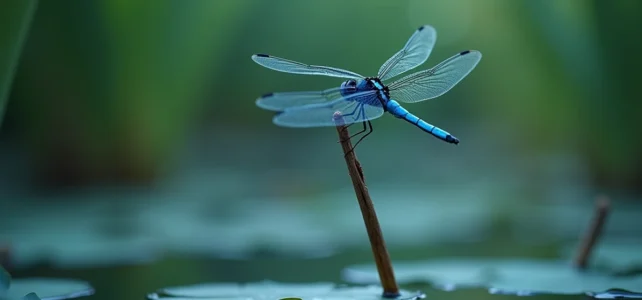
We walk along a stream, stop to observe a reflection on the water, and a blue dragonfly lands just a few centimeters away. The scene lasts barely a few seconds, but it leaves an impression. In symbolic and energetic interpretations, this encounter with a blue dragonfly carries a particular significance, linked to its color, the movement of the insect, and what we project onto the moment.
Blue Dragonfly and Ecological Indicator: A Concrete Signal Before the Symbol
Before any spiritual interpretation, the presence of a dragonfly at a site informs us about the state of its environment. Naturalists use these insects as sentinels of aquatic biodiversity. Their return to a river or wetland indicates a concrete improvement in the habitat: less polluted water, restored vegetation, a functional food chain.
This point changes the significance of the symbol. Encountering a blue dragonfly is not just about receiving a “message”: it is also about being in a place where life is returning. Recurring heat waves disrupt European biodiversity, and species associated with aquatic environments are increasingly vulnerable to climatic extremes. Observing a blue dragonfly in this context means coming across an animal whose mere presence signifies a balance that is still preserved.
Understanding what it means to see a blue dragonfly gains depth when we integrate this naturalistic dimension into the symbolic reading.

Symbolism of the Blue Color in the Dragonfly: Throat, Calm, and Clarity
The dragonfly, regardless of its color, is associated with transformation and adaptation. Its metamorphosis, from aquatic larva to aerial insect, makes it a totem animal of change in many traditions. The blue color adds an additional layer.
Blue relates to communication, inner depth, and calm. In the chakra system, this hue corresponds to the throat chakra, an energy center linked to self-expression and the ability to articulate what one feels accurately.
What the Blue Color Activates in Energetic Reading
- The throat chakra (Vishuddha) is associated with authentic speech. A blue dragonfly, in this context, invites us to check if we are holding back words or expressing ourselves freely.
- Deep blue may also evoke the third eye (Ajna), related to intuition and mental clarity, depending on the shades of blue observed on the insect.
- Emotionally, the color blue is often associated with soothing, an invitation to slow down a tense situation or to take a step back.
Responses vary on this point: some people describe an immediate sense of relief after encountering a blue dragonfly, while others see it merely as a pretty insect. The interpretation depends on one’s state of mind at the moment and individual belief systems.
Energy of the Blue Dragonfly: Transformation, Lightness, and Emotional Grounding
The dragonfly is often associated with lightness. Its rapid flight, instant changes in direction, and ability to hover over water create an image of total flexibility. Applied to a life situation, this symbolism invites us to not remain stuck in a posture or emotion.
The blue dragonfly takes this symbolism further. The blue tempers the speed. Where an orange or red dragonfly might evoke raw energy or passion, the blue one points towards a thoughtful, measured change. We speak of a renewal that comes through understanding rather than impulsive action.
Presence of the Dragonfly and Emotional State
In practices related to totem animals, encountering a specific animal is read as a mirror of one’s inner state. Coming across a blue dragonfly in a moment of doubt or tension can be interpreted as a signal for rebalancing: the situation calls for communication (throat chakra) and clarity (third eye), not brute force.
This type of reading is not scientifically proven, but it structures a common practice. The symbol functions as a tool for self-awareness, a pretext for reflecting on what one is going through.
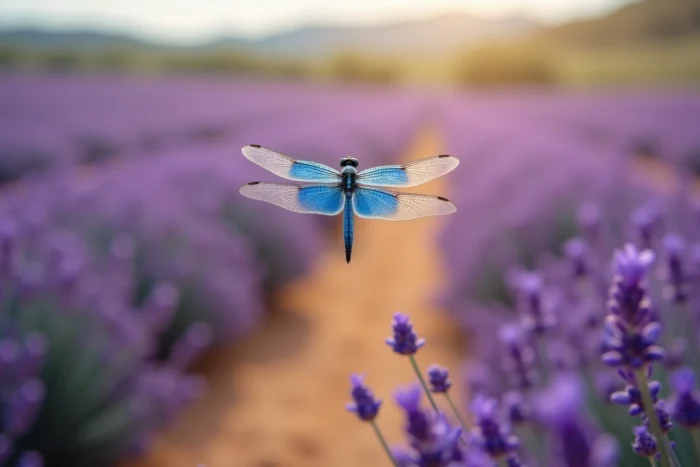
Blue Dragonfly and Chakras: Practical Correspondences
The correspondence between animal colors and chakras is not standardized. There is no official chart validated by a single authority. However, recurring associations can be found in literature on totem animals and energy work.
| Color of the Dragonfly | Associated Chakra | Theme |
|---|---|---|
| Blue | Throat (Vishuddha) | Expression, communication, inner truth |
| Dark Blue / Indigo | Third Eye (Ajna) | Intuition, clarity, vision |
| Orange | Sacral (Svadhisthana) | Creativity, emotions, pleasure |
| Green | Heart (Anahata) | Love, balance, compassion |
This table provides a framework for interpretation, not an absolute truth. The interest lies in having a grid to question one’s own situation at the moment of encountering the insect.
How to Use This Grid in Daily Life
Observing the color of a dragonfly and relating it to a chakra can serve as an entry point for a self-observation practice. If you frequently encounter blue dragonflies, the question to ask yourself concerns the throat: are you holding back words, avoiding a conversation, stifling a verbal emotion?
The exercise requires neither materials nor training. It is simply about allowing the animal to play the role of an attention trigger, like a visual reminder anchored in reality.
The blue dragonfly remains a fragile insect, whose presence depends on the quality of aquatic ecosystems. The fact that its encounters are becoming less frequent in certain regions makes each observation all the more significant, whether one reads it as an energetic symbol or simply as a sign of a still-living natural environment.