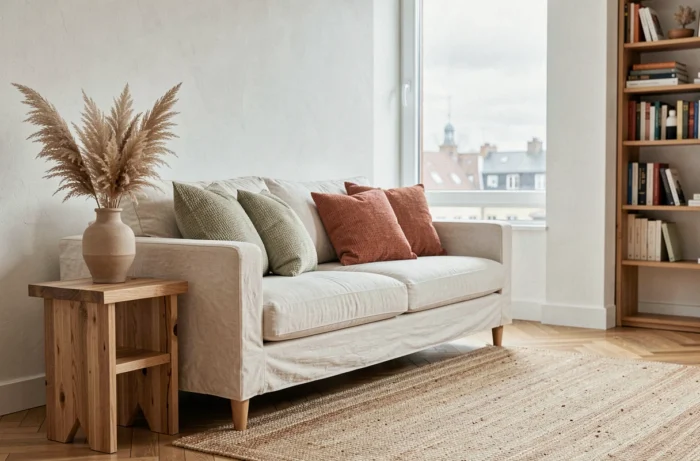
Sublimating an interior is not just about choosing a wall color or replacing a sofa. It’s a balancing act between materials, light, textures, and regulatory constraints that evolve each year. Understanding these parameters allows for sustainable choices, far from fleeting fashion trends.
Biosourced materials in interior decoration: what RE2020 changes
The environmental regulation RE2020 pushes the construction and renovation sector towards biosourced materials: wood, hemp, linen, cork, cellulose wadding, wood fiber. This dynamic, confirmed by the French Building Federation in a publication from September 2026, does not only concern structural work. It directly influences decoration and interior design choices.
A wood fiber panel used as interior insulation modifies the acoustics of a room and its thermal comfort. A lime-based coating or a lightweight biosourced plaster changes the texture of a wall as much as its hygrometric performance. These materials are not just simple ecological alternatives; they transform the feel of a space.
The FFB specifies that wood fiber will be integrated into all NF DTU standards starting May 30, 2027, which will grant it the status of common technique. For renovation projects launched now, this means that the insurability of these solutions will simplify in the coming months. In the meantime, checking the insurer’s agreement in advance remains necessary, as some biosourced products still fall outside the scope of the traditional ten-year guarantee.
The publications available on the home section of News Déco allow you to follow these developments throughout the seasons and identify materials that transition from experimental status to common solutions.
Formaldehyde in furniture: a constraint that guides your furniture choices
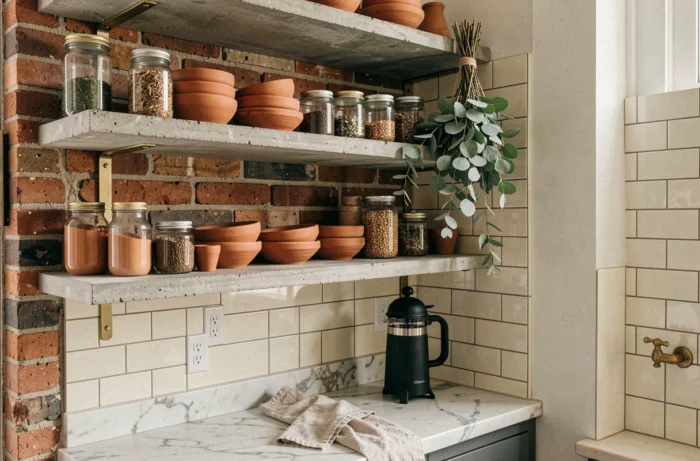
Since August 6, 2026, the European Union has tightened requirements on formaldehyde in furniture and wood-based products through the REACH regulation. This tightening directly impacts living room, bedroom, and kitchen furniture available on the French market.
Formaldehyde is a volatile organic compound found in the glues and resins of many particle boards. It is classified as carcinogenic. The new European regulation imposes lower emission thresholds, prompting manufacturers to reformulate their adhesives or switch to panels without added formaldehyde.
For an interior decoration project, this constraint has a practical consequence: solid wood or certified low-emission panel furniture becomes a more relevant choice than entry-level standard particle board. A storage unit made of solid walnut or oak veneered on a formaldehyde-free panel costs more upfront, but it will not degrade indoor air quality.
Color palette and textures: choices that stand the test of time
Warm and earthy colors dominate the season: terracotta, brown, ochre, eggplant. They are set against a base of neutral tones (off-white, greige, beige) that remains a safe bet for a lasting interior. This palette works because it naturally harmonizes with the raw materials that the biosourced trend highlights.
- Terracotta pairs with light wood and raw linen for a warm effect without saturation. An accent wall in this shade is enough to refocus a living space.
- Tobacco brown and eggplant serve as accent colors on a chair or rug, without needing to repaint the entire room.
- Neutral tones (lime, stone, sand) in mineral paint offer a slightly irregular matte texture that absorbs light differently than smooth acrylic paint.
Leaf-patterned wallpaper is making a comeback in wall decoration projects. Applied to a single wall, it creates visual depth in a small space. A common mistake is to apply it to all four walls of a room, which compresses the volume instead of revealing it.
Paint or coating: the choice that changes the light
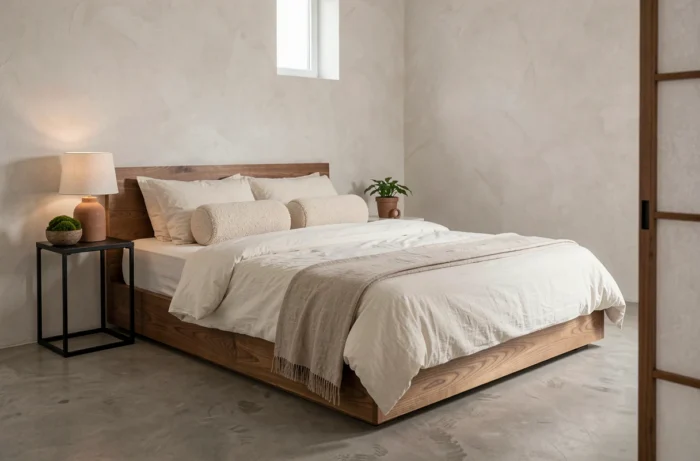
A classic matte paint and a lime coating do not reflect light in the same way. The coating diffuses natural light unevenly, giving the walls a visual vibration absent from a flat paint surface. In a north-facing room, this difference in rendering can partially compensate for the lack of brightness.
For kitchens or bathrooms, tadelakt coatings or mineral paints resist moisture better than air lime coatings. The choice depends on the room’s use, not just the desired color.
Biophilic design: integrating plants without turning your living room into a greenhouse
Biophilic design refers to the integration of natural elements (plants, water, natural light, raw materials) into an interior space to enhance the well-being of occupants. This concept goes beyond simply placing three green plants on a shelf.
A stabilized green wall (moss or preserved foliage that requires no maintenance) provides real texture and acoustic absorption in a living room or office. Lattice screens in perforated wood separate spaces while allowing light to flow through. Planters integrated into furniture (bench with plant box, green library) merge decorative and utilitarian functions.
- Favor plants suited to the actual light conditions of the room rather than decorative species that will wither in a few weeks.
- Combine plants with coherent materials: ceramics, raw wood, aged brass, rattan.
- Limit the number of visible pots by opting for recessed or hanging containers, which free up floor space.
A successful biophilic interior relies on the coherence between plants, light, and materials, not on the quantity of accumulated plants. Two or three well-positioned elements create a more pronounced effect than a dozen pots scattered without logic.
The new regulatory constraints on materials and pollutant emissions converge with current aesthetic trends. Choosing certified solid wood furniture, mineral coatings, or biosourced insulation is no longer just an ecological gesture: it is also, concretely, what gives an interior its texture, light, and durability.