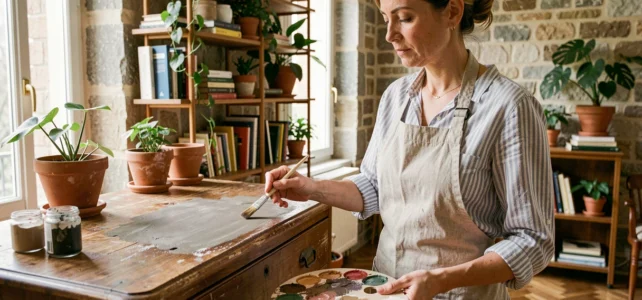
A sofa moved a few dozen centimeters, a wall repainted in a more muted shade, a light fixture placed in the right spot: the transformation of an interior often relies on precise gestures rather than major renovations. Creative home solutions allow you to change the perception of a room without touching the structure. You just need to know which levers to prioritize and in what order.
Tactile materials and organic shapes: the true starting point of an interior transformation
Most articles on redesigning start with wall colors or furniture arrangements. Before getting there, ask yourself a more useful question: what materials dominate your room?
The current decor trend is shifting towards calmer, tactile, and natural interiors. Raw wood, thick linen, exposed or reconstituted stone are making a strong comeback. These materials change the atmosphere of a room much more than a color change. A solid oak tabletop placed on an existing metal base transforms a dining area without buying new furniture.
Organic shapes (rounded, asymmetrical) replace strictly geometric lines. An oval mirror instead of a rectangular one, an irregular stoneware vase on a shelf: these details create a feeling of a lived-in space rather than a decorated one. If you’re looking to explore home solutions on Niddou, you’ll find concrete ideas for combining these materials with different styles.
Have you ever noticed that a completely smooth room (melamine, glass, plastic) feels cold even with the heating on full? It’s the lack of texture that produces this effect. Adding a thick wool throw on a leather sofa or placing a jute rug under a glass coffee table is enough to break this coldness.
Indoor lighting: structuring space with light rather than furniture
Lighting is the most underestimated transformation lever. A single ceiling light in the center of a room flattens the volumes and dulls the colors. Multiplying light sources at different heights radically changes the perception of space.
Three levels are enough to structure a room:
- An indirect high light (wall lamp directed towards the ceiling or LED strip behind a tall piece of furniture) to visually enlarge the room
- A medium light at eye level (table lamp on a sideboard, low pendant above a table) to create activity zones
- A low light (floor lamp with a shade directed towards the ground, string lights placed in a glass jar) to set an evening ambiance
The color temperature matters as much as the intensity. A cool white bulb in a living room gives an impression of a waiting room. Opt for a temperature around 2,700 kelvins for living spaces, which is warmer and more enveloping.
Sculptural lamps, made of ceramic or textured metal, become decorative objects in their own right. A well-chosen light fixture can sometimes replace a painting.
The common mistake: lighting everything the same way
In an open kitchen that leads into a living room, using the same light source for both areas blurs the separation. Install a lower and cooler pendant above the work surface, and keep a dim light in the living room area. This difference in temperature creates a visual boundary without a partition.
Modular furniture and vertical storage for small spaces
When space is limited, the temptation is to buy smaller furniture. This is often a mistake. A well-sized modular piece is better than three small pieces that clutter the passage.
Folding wall-mounted tables (folding desk, wall table) free up floor space when not in use. A solid wood model with sturdy hinges can support a laptop and a meal without wobbling.
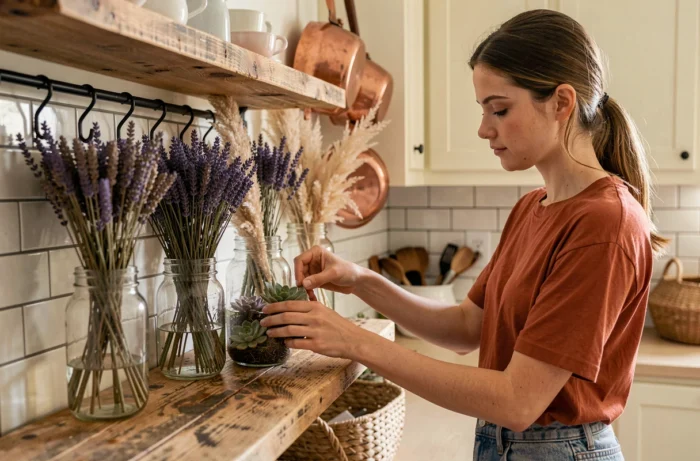
Vertical storage takes advantage of the ceiling height, a volume that is generally wasted. Open shelves installed between the tops of doors and the ceiling can hold wicker baskets or boxes. This high storage remains accessible with a small step stool and completely clears the floor.
Repurposing an existing piece rather than buying a new one
An old wooden step ladder becomes a bathroom shelf for towels. An old trunk serves as a coffee table with built-in storage. Repurposing extends the life of a piece of furniture and gives a unique character to the room.
Why does this choice work better than new furniture? Because an unexpected object draws the eye and creates a focal point. A room where everything matches and is new looks like a catalog. An unexpected element breaks this uniformity.
Paint and color: act on a single wall for maximum effect
Repainting an entire room takes time and budget. Repainting a single wall, the one facing the entrance of the room, creates an immediate sense of depth. This is the principle of the accent wall.
For a bedroom, a muted shade (sage green, blue-gray, terracotta) on the wall behind the headboard is enough to anchor the space. In a living room, a dark-colored wall behind a bookshelf highlights the displayed objects and creates a niche effect.
Paint is not limited to walls. Repainting kitchen cabinet doors in a contrasting color refreshes the entire room. An olive green on existing white facades, for example, transforms a basic kitchen into a space with character.
Every action counts more when it is targeted. It’s better to have one well-thought-out intervention than ten scattered adjustments. Start by identifying what bothers you the most in a room, whether it’s the light, the flow, or the atmosphere, and focus your efforts on that specific point. The rest will follow naturally.