
When you want to create a smoke effect at home for a children’s workshop, a short film, or Halloween decoration, the first instinct is often to look for baking soda in the kitchen cupboard. The product is accessible, inexpensive, and associated with all sorts of fun experiments.
Baking soda alone does not generate real dense smoke: when heated, it decomposes into sodium carbonate, water vapor, and carbon dioxide. The visible cloud obtained comes from fine particles or condensed vapor, not from combustion.
Understanding this chemical reality changes the way to prepare the experiment. Nevertheless, it is possible to achieve a convincing visual result, provided you combine the right ingredients and follow a few precautions.
Baking soda and vinegar reaction: what really happens in the glass
The most shared recipe on social media involves pouring white vinegar over baking soda in a container. The fizzing produces CO2 in large quantities, and if you add a bit of hot water, the steam released creates a light mist above the glass.
The problem is that this mist remains subtle. To amplify it, we work on three concrete levers.
- The volume of reactants: using a wide container (mixing bowl or shallow pot) allows the gas to disperse in a sheet rather than in a thin column, which gives a more spread-out smoke impression.
- The temperature of the water: adding well-heated water (not boiling, to avoid splashes) increases the amount of visible steam that mixes with the CO2.
- Food coloring: a few drops in the mixture do not color the “smoke” itself, but make the bubbling more spectacular to film or observe, especially for children.
Detailed protocols can be found on the Ceze website that specify the proportions and possible variations depending on the desired effect.
Heated sugar and baking soda: the smoke snake method
This experiment, sometimes called “black snake” or “pharaoh’s snake,” produces a much more visual effect than simple fizzing. You mix baking soda with powdered sugar, place the mixture on a bed of sand in a heat-resistant container, then soak the sand with a bit of rubbing alcohol before igniting it.
The sugar caramelizes and carbonizes, releasing gas, while the baking soda decomposes and pushes the carbon mass upward. The result is a swirling black column accompanied by smoke wisps. The spectacle lasts one to two minutes, the time it takes for the fuel to burn out.
Concrete precautions for this handling
Work outdoors or in a very well-ventilated room. The sand acts as a thermal insulator: without it, the bottom of the container can reach a temperature sufficient to crack the glass or mark a countertop.
Keep a glass of water nearby to extinguish the flame if necessary. Rubbing alcohol ignites quickly, and the flame is sometimes hard to see in broad daylight. For workshops with children, an adult manages the ignition and the flame, while the children observe from a distance.
Ground fog effect with baking soda and ice: a flame-free alternative
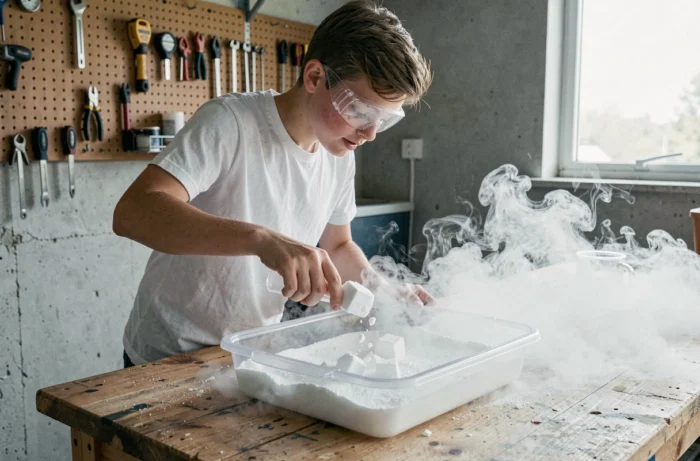
For those who want to avoid any flame, a variant involves combining the baking soda-vinegar reaction with regular crushed ice in a large container. The CO2 released, being heavier than air, creeps along the ground. If you add warm water to the ice at the same time, the condensation of the steam amplifies the mist.
The result does not approach the density of a professional smoke machine, but is sufficient for a table decoration, a small home film, or a party setup. Feedback varies on this point: depending on the size of the container, the ambient temperature, and the ventilation of the room, the effect can last from a few seconds to a minute.
Optimizing the duration of the visual effect
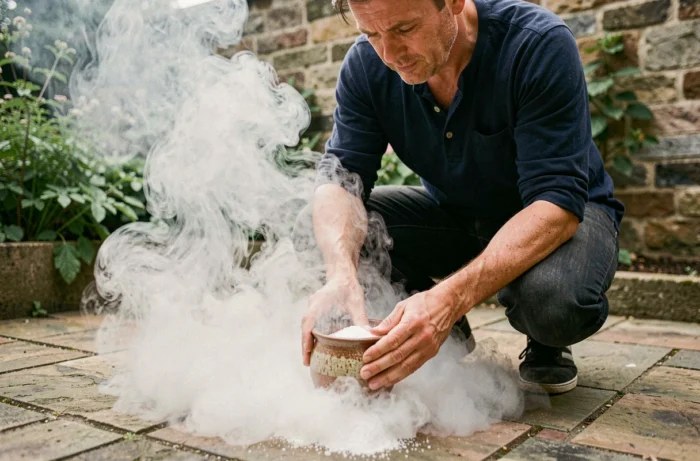
Add the vinegar in small successive amounts rather than all at once. Each addition reignites the fizzing and prolongs the production of CO2. Preparing several small bottles of pre-measured vinegar in advance makes the handling smoother, especially if filming the scene.
Safety and ventilation: the real risks of a home smoke experiment
Food-grade baking soda is not toxic in the classical sense. The main risk lies in inhaling fine dust and eye irritation. The product’s safety data sheets recommend getting fresh air in case of prolonged inhalation and rinsing the eyes thoroughly in case of contact.
When heating baking soda, the residue obtained is no longer food-grade baking soda but sodium carbonate, a more alkaline and irritating product. Handling the residue with bare hands after a black snake experiment can cause skin irritation. Use gloves or wait for complete cooling before cleaning.
- Work in a ventilated space, with a window open or outdoors.
- Wear protective goggles if handling vinegar in large quantities (acidic splashes can irritate the eyes).
- Never use technical baking soda for an experiment involving food or skin contact: its purity is insufficient.
- Keep smoke detectors away from the experiment area, as even a small release can trigger the alarm.
A home baking soda smoke effect remains modest compared to dry ice or a dedicated machine. The real value of these experiments lies in their educational dimension: observing an acid-base reaction, understanding thermal decomposition, handling quantities. For a purely decorative large-scale effect, other solutions will be more suitable. But for an afternoon of family experiments, baking soda and a bit of vinegar are enough to create a memorable moment.