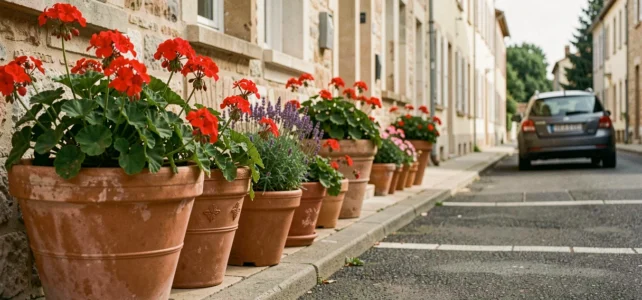
A neighbor placing a large flower pot right in front of their house, at the edge of the road, to discourage anyone from parking there: this scene is common in many residential streets. The reflex seems harmless, sometimes even aesthetic. However, legally speaking, placing flower pots in front of one’s house to reserve a parking space is considered a punishable practice, regardless of the object used.
Civil liability and flower pots on the sidewalk: the underestimated risk
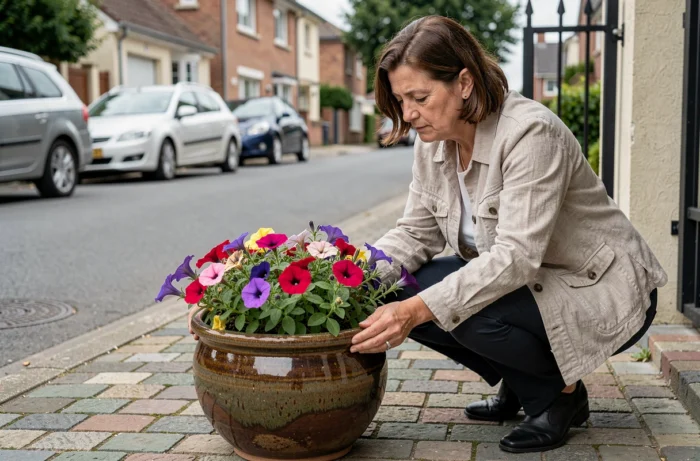
People often think about the fine, but rarely about what happens if someone gets injured. A flower pot placed on a sidewalk or at the edge of the roadway, even if it appears stable, can tip over due to wind, a bump, or repeated passage of strollers and wheelchairs.
If a pedestrian trips, if a cyclist swerves to avoid the obstacle, if a child cuts themselves on a shard of broken terracotta, the civil liability of the occupant is engaged. We are no longer talking about a simple fine, but about covering medical expenses, or even facing legal action in case of serious injuries.
This point is all the more delicate as many home insurance contracts cover damages caused inside the dwelling or in its private dependencies, but not those caused by an object placed on public property without permission. Before even wondering if one risks a fine, one should check if one can place flower pots in front of their house without exposing themselves to an insurance gap.
Sidewalk and public communal domain: why no resident has exclusive rights
The sidewalk in front of a house is part of the public communal domain. Its use is designated for pedestrian traffic. Even if one has maintained it for years, even if one has financed the curb or replaced the slabs, this does not create any right of occupancy.
Placing an object in this space without permission, whether it is a barrier, an overturned trash can, or a flower pot, constitutes illegal occupation of public space. The classification does not depend on the nature of the object or its decorative aspect: it is the act of occupying a space designated for collective use for private purposes that poses the problem.
Contravention and removal by authorities
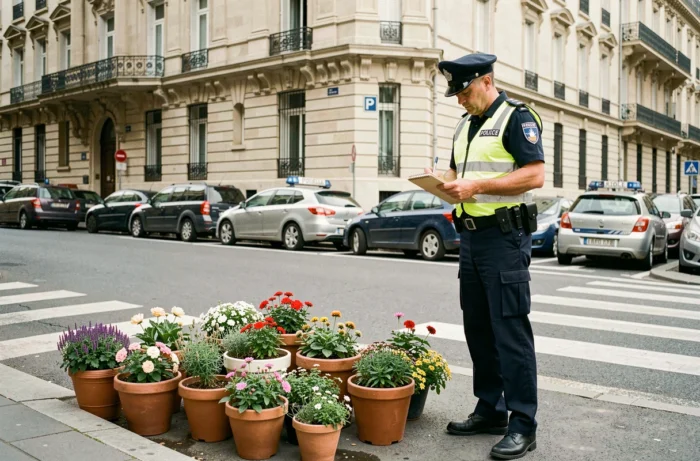
The fine incurred falls under the 4th class. The municipality may also proceed with the removal of objects, sometimes without notice in densely populated urban areas. Responses vary on this point depending on the cities: some notify by mail, others remove directly after a report.
There is no uniform national rule regarding the tolerance of flowered sidewalks. What is encouraged in one municipality (participatory greening, flower permits) may be sanctioned in the neighboring municipality. It all depends on the municipal order in force and local political will.
Greening the sidewalk without reserving a space: the framework of greening permits
Several French cities offer a system called “greening permit” which allows residents to install planters or plant at the foot of their facade. This framework exists precisely to distinguish beautification from appropriation.
The conditions imposed by these systems clearly show the line of demarcation:
- Plantings must not obstruct pedestrian traffic, with a free passage maintained (often at least half the width of the sidewalk)
- The declared objective must be greening, not the privatization of a parking space
- The beneficiary commits to maintaining the plants and removing the installation if requested by the municipality
- No large or heavy object should create a dangerous obstacle for people with reduced mobility
In other words, a municipality can encourage greening the space in front of one’s home while sanctioning someone who uses that same planter as a parking barrier. Decorating does not equate to reserving.
Legal alternatives to protect access in front of one’s home
When the real problem is recurring obstructive parking (vehicles blocking a garage entrance, vans parked on a driveway), there are levers that do not involve self-justice with a geranium pot.
Request for ground marking or sign
One can request the town hall for the installation of a no-parking sign in front of a driveway, or the marking of a driveway. This administrative procedure is the only one that provides a legal basis for penalizing improperly parked vehicles.
Reporting to law enforcement
A vehicle parked in front of a garage access marked by a lowered sidewalk is committing an offense under the Highway Code. Contacting the municipal police remains the most direct recourse, even if response times vary by municipality.
Request for temporary occupation permit
For a specific need (work, moving), it is possible to request a temporary parking permit from the town hall. This administrative title is the only document that legally allows reserving a space on public property for a limited time.
Co-ownership and common areas: a frequent confusion
In co-ownership, the situation becomes more complicated. The inner courtyard, residential parking, or private sidewalk (which belongs to the co-ownership and not to the municipality) is governed by the co-ownership regulations, not the Highway Code.
A co-owner who places flower pots in a common courtyard to “mark” their usual spot may be reminded of the rules by the property manager. Common areas cannot be appropriated by a single co-owner, even symbolically. The property manager can demand removal and, in case of refusal, take the matter to the judicial court.
The distinction is significant: on public property, it is the municipality that imposes sanctions. In co-ownership, it is the property manager who acts on behalf of the collective. In both cases, the flower pot creates no rights.
Whether on a public sidewalk or in a co-ownership courtyard, the fundamental rule remains the same: a shared space cannot be privatized with an object, however flowery it may be. Remedies exist, but they go through the town hall, the property manager, or the municipal police, never through a geranium pot placed in the early morning.