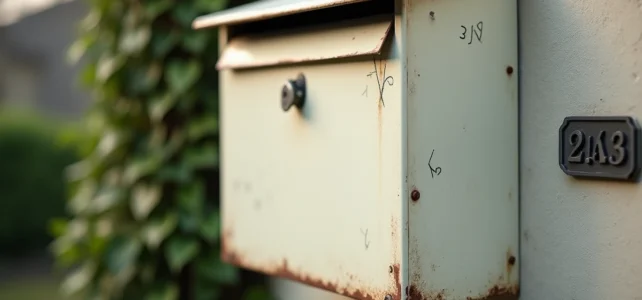
Burglaries often start with the burglars scouting a residence before breaking in. This scouting often involves a discreet marking system placed on or near the mailbox, intended to convey information to accomplices: security level, occupants’ habits, presence of a dog. These visual codes take the form of chalk symbols, small objects positioned unusually, or nearly invisible marks on the front door.
Micro-markings on the door and mailbox: recent methods
Chalk lines and stones are still used, but several prevention sources have described much more discreet techniques in recent years. The principle remains the same: to check if an occupant is present and attentive to their surroundings.
The method of clear glue or silicone dot involves placing a micro-drop between the door and its frame. This nearly invisible thread breaks if the door is opened. When it remains intact after several days, the residence is considered unoccupied.
Variations exist: a very thin adhesive thread, a small clear sticker, a toothpick wedged in the door seal. These markings are sometimes placed directly on the mailbox or just behind it, to determine if it is being regularly handled. Spotting mailbox marking signs requires reviewing these details each time you return home.
To detect these traces, using the smartphone’s flashlight in low light remains the most effective gesture. By sweeping the surface of the door, the frame, and the flap of the mailbox at a low angle, glue residues or micro-stickers become visible.
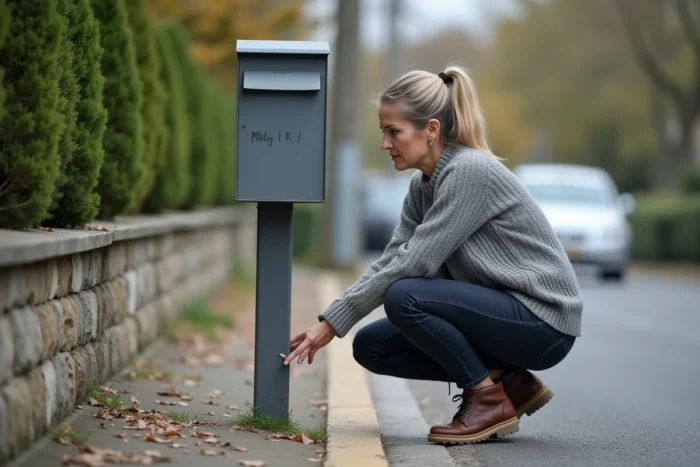
Chalk symbols: meaning of the marking codes
Chalk, marker, or stone markings remain the most documented coding system. Each symbol conveys specific information to accomplices who will follow after the scout.
- A cross generally indicates that the residence is an interesting target, either due to the presumed value of the goods or ease of access.
- A diamond signals that the house is unoccupied. This sign is frequently found on mailboxes or adjacent walls during holiday periods.
- A triangle may indicate the presence of a woman alone at home. The letter “D” signifies a Sunday favorable for intrusion, while “AM” points to a morning time slot.
- Small circles drawn on the ground or on the gate serve a function similar to stones: they act as discreet visual markers to confirm that a first pass has occurred.
These symbols are not universal. The codes vary by networks and regions. An isolated sign is not enough to confirm a scouting, but multiple combined markings in the same area constitute a serious warning signal.
Stones and moved objects near the gate: an absence test
Before chalk or glue, the oldest method involves placing a small object in a specific spot: a stone on the doormat, a twig against the door, a flyer slipped in a certain way into the mailbox. The principle relies on passive observation.
If the object has not moved after a day or two, the burglar deduces that no one has passed. A mailbox overflowing with mail works exactly the same way: it visually confirms the prolonged absence of the occupants without requiring any active marking.
The peculiarity of this technique is that it leaves no suspicious trace. A stone in front of a gate goes unnoticed. It is their repetition or unusual positioning (aligned, placed on a specific step, always in the same spot after removal) that should raise alarm.
External elements that facilitate scouting
Some details visible from the street provide information without any marking being necessary. A tall, opaque hedge, for example, protects both the burglar and the occupant: it conceals the front door and allows for a break-in out of sight.
Constantly closed shutters, the absence of a vehicle for several days, and outdoor lighting that is never turned on are all clues exploited during scouting. The burglar looks for the convergence of multiple signals, not a single clue.

Reacting after discovering a suspicious marking on your mailbox
Photographing the marking before erasing it is the first useful reflex. The timestamped photo allows you to report the incident to law enforcement with a concrete element.
- Immediately clean the symbol or remove the suspicious object. This indicates to the scout that the residence is being monitored by its occupants.
- Notify nearby neighbors. A marking on a mailbox often concerns several homes in the same area.
- Check access points: locks, windows, gate, garage. Scouting sometimes precedes an intrusion attempt by a few days to several weeks.
- Vary your visible habits: change lighting schedules, have the mail collected during absences, and avoid leaving the shutters in the same position for several consecutive days.
Installing a camera or an alarm system visible from the outside changes the burglar’s calculations. A residence visibly equipped with a security system is abandoned in favor of an easier target. The marking, however discreet, loses its value as soon as the occupant shows that they have detected the scouting.
The factor of time plays a crucial role. The time between scouting and an attempted break-in varies from a few days to several weeks depending on the networks. Erasing a marking on the same day it appears remains the most direct response to signal that the house is not an easy target.