
Choosing an electric hedge trimmer involves balancing three technical parameters that do not compensate for each other: blade length, tooth spacing, and power source. Depending on the type of plants, the area to be maintained, and the noise restrictions imposed by the municipality, the suitable model can vary significantly. This article measures the concrete differences between the available options to identify the criteria that weigh most in the decision.
Noise level and local regulations: the criterion that few gardeners anticipate
Most choice guides compare power, weight, and battery life. Noise, however, is often treated as a comfort detail. This is a framing error.
In France, many municipal or prefectural orders limit motorized gardening to specific time slots, often around 8 AM – 12 PM and 2 PM – 7 PM on weekdays, with a reduced window on Sundays (sometimes only 10 AM – 12 PM). The legal framework relies on Article R1336-5 of the Public Health Code regarding neighborhood noise.
A wired electric hedge trimmer generates less noise than a thermal model. Battery versions go even further in noise reduction. During tight time slots, being able to work without risking conflict with neighbors is not a luxury; it is an operational constraint. The catalogs available on taille-haie-electrique.com allow for comparing models while considering this often underestimated parameter.
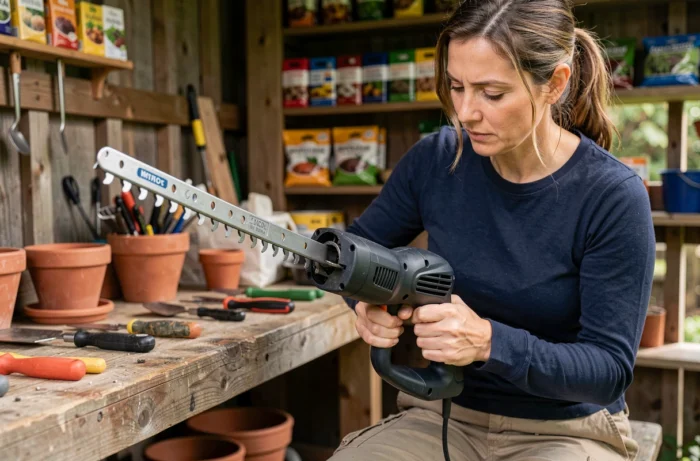
Wired or battery hedge trimmer: comparative table of technical differences
The two main families of electric hedge trimmers (wired and battery) do not cater to the same user profile. The table below summarizes the structural differences.
| Criterion | Wired Electric | Battery (Cordless) |
|---|---|---|
| Range | Limited by cable length and extension | Free, depends on battery life |
| Noise level | Moderate | Generally lower |
| Weight | Lighter (no built-in battery) | Heavier due to the battery pack |
| Battery life | Unlimited as long as there is a socket | Variable depending on battery capacity |
| Maintenance | Minimal | Management of battery charging cycles |
| Height maneuverability | Cable can be cumbersome for tall hedges | Total freedom of movement |
The wired option remains relevant for small gardens where an outdoor socket is in immediate proximity. However, as soon as the hedge exceeds twenty meters in length or the terrain requires frequent movement, the battery model eliminates the cable constraint and reduces the risk of accidental wire cuts.
Why battery models have dominated among individuals since 2024
Recent comparisons confirm a clear trend: for private gardens, battery models have overtaken traditional wired ones. Maneuverability and reduced noise explain this shift. Current lithium-ion batteries offer sufficient energy density to cover one to two trimming sessions without intermediate recharging.
Blade length and tooth spacing: what the hedge demands
The blade length determines the cutting width in a single pass. A short blade (around 40 cm) is suitable for topiaries and small ornamental hedges. For hedges or plant fences exceeding one meter in height, a longer blade (55 to 70 cm) reduces the number of passes and working time.
The spacing of the teeth determines the maximum diameter of the branch being cut. A narrow spacing is sufficient for the year’s shoots on privet or laurel. Hedges of hornbeam or beech, whose branches lignify quickly, require wider spacing to prevent branches from getting stuck between the teeth.
- Young hedge or fine foliage (boxwood, privet): short blade, narrow spacing, lightweight model
- Mixed medium hedge (laurel, photinia): intermediate length blade, medium spacing
- Dense wild hedge (hornbeam, beech, hawthorn): long blade, wide spacing, high power
- Tall hedge requiring elevated work: telescopic model or pole hedge trimmer
Adapting the blade to the plant avoids two common pitfalls: a jagged cut that weakens the plant, or a mechanical blockage that prematurely wears out the motor.
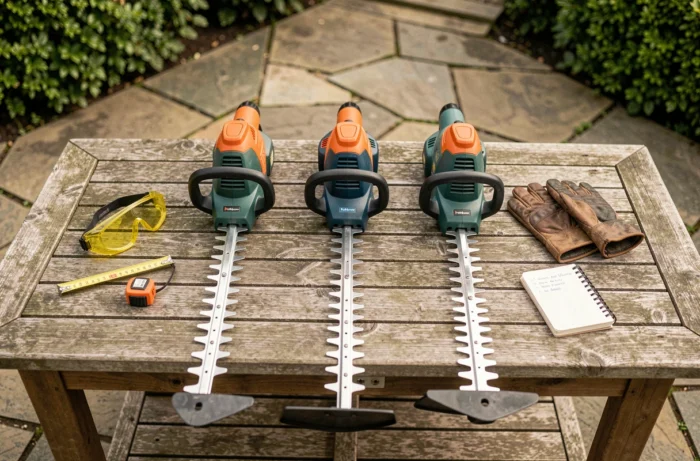
Weight and ergonomics of the electric hedge trimmer: the impact on working duration
A hedge trimmer is held at arm’s length, often at height, during sessions that easily exceed half an hour. Weight then becomes the limiting factor, well before power.
A device that is too heavy reduces cutting precision after a few minutes. Arms tire, the cutting line wavers, and the result suffers. Wired models, lacking a battery pack, generally weigh less than their cordless counterparts. The weight difference between a wired and a battery model varies depending on the ranges.
Rotating handle and anti-vibration
Two ergonomic elements deserve particular attention when choosing. The rotating handle allows switching from a horizontal cut (top of the hedge) to a vertical cut (sides) without twisting the wrist. The anti-vibration system, present on mid- to high-end models, limits muscle fatigue during long sessions.
A well-balanced hedge trimmer, with the center of gravity close to the hands, can be used longer than a lighter model that is poorly balanced. Overall balance matters as much as the gross weight displayed on the technical sheet.
Blade maintenance: frequency and method to preserve the cut
A poorly maintained blade tears instead of cutting. After each use, removing sap and plant residues with a dry cloth prevents oxidation. A spray of suitable lubricant on the teeth limits overheating and preserves sharpness.
Sharpening depends on the intensity of use. For domestic use (two to three trims per season), annual sharpening is generally sufficient. Double-edged blades, where both rows of teeth move simultaneously, provide a cleaner cut but require more meticulous sharpening.
Replacing a dull blade often costs less than a motor repair caused by excessive cutting effort transmitted to the mechanics. Checking the condition of the teeth before each season remains the most cost-effective maintenance gesture.