
The string trimmer is one of those tools whose impact on the final appearance of a garden is often underestimated. A lawn mower always leaves untouched areas along walls, flower beds, or paths. The string trimmer comes into play precisely where the mower cannot reach, and choosing the right model determines both the quality of the finish and the comfort of use throughout the season.
Shared battery platform: the criterion that comparisons overlook
Most guides focus on power or cutting width. However, a crucial criterion that remains under-discussed is the battery compatibility with other garden tools. Husqvarna, Ryobi, and other manufacturers offer systems where the same battery powers the mower, hedge trimmer, and string trimmer.
This choice has direct consequences on the budget. Buying a string trimmer whose battery works with three or four other devices reduces the overall cost of the equipment. Conversely, opting for an isolated brand requires multiple chargers and batteries, which increases the bill and clutters storage.
To compare models and their battery ecosystems, detailed sheets on taille-bordure-warrior.com allow for cross-referencing technical characteristics by platform. This type of cross-reading prevents purchasing a high-performance device that is incompatible with the rest of your equipment.

Battery, corded, or gas string trimmer: what the terrain demands
The type of motorization should not be chosen based on an abstract ranking. It depends on the actual configuration of the garden.
Corded model: limited but sufficient under certain conditions
The corded electric string trimmer remains the lightest and most affordable. Its power, which varies by model from a few hundred watts to nearly a thousand watts, is suitable for soft grass and regular finishes. However, the cord limits the range of action and requires an outdoor outlet nearby.
For a compact city garden, without distant corners, this is a rational choice. Beyond a certain area, the extension cord becomes a real hindrance to maneuverability.
Battery model: the market shift
The consumer market is clearly shifting towards lithium-ion battery string trimmers, particularly the 18 V and 36 V models. Several factors explain this shift: absence of a cord, reduced noise level (a concrete advantage in light of local noise restrictions), and especially integration into multi-tool platforms.
Field feedback diverges on one point: autonomy. Depending on the grass density and frequency of use, a standard battery may suffice for a complete session or run out before finishing the garden tour. Having a second battery eliminates this risk, but increases the initial cost.
Gas model: raw power for difficult terrains
The gas string trimmer remains relevant for large plots, sloped terrains, or tall, dense grasses. Its engine power far exceeds that of electric models. In return, it is heavier, generates noise, requires regular maintenance (oil changes, spark plug, filter), and consumes fuel.
For typical residential use, the gas model is oversized. It finds its place among users who maintain large areas or zones left fallow for part of the year.
Cutting line and brushcutter head: the details that change the finish
The cutting system directly influences the sharpness of the result and the frequency of consumable replacements.
- The round line is suitable for soft grass and common finishes. It wears out quickly on thick grasses or when in contact with hard surfaces (walls, concrete edges).
- The serrated or star-profiled line better tackles resistant grasses. It reduces engine effort and produces a cleaner cut on tall grasses.
- The automatic or semi-automatic line loading head avoids repeated manual stops. During a long session, this mechanism saves considerable time compared to a manual feed system.
The cutting width, often between twenty and forty centimeters depending on the models, determines the speed of work. A larger width speeds up the passage over long borders, but makes the tool less precise in tight corners.
Ergonomics and weight of the string trimmer: an underestimated factor
A string trimmer is used with arms extended, often in a slightly bent position. After twenty minutes, fatigue sets in if the tool is poorly balanced or too heavy. The weight and load distribution matter as much as the power.
Three elements deserve attention before purchase:
- The presence of a harness or an adjustable secondary handle, especially on heavier gas models.
- The ability to adjust the height of the telescopic tube to adapt the tool to one’s size and avoid bending.
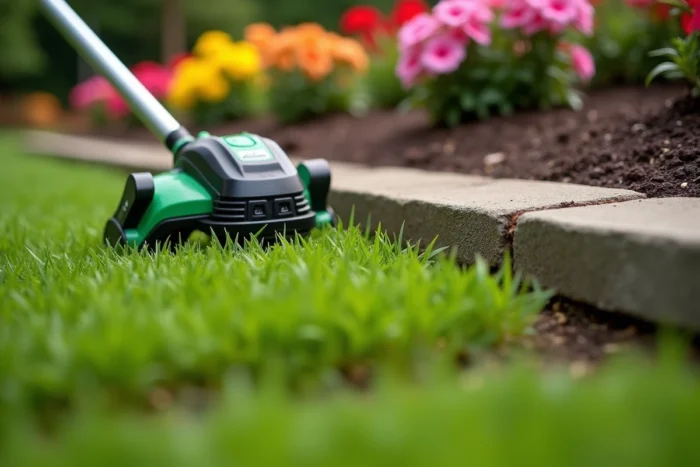
- The tilt of the cutting head, which allows switching from horizontal finishing (lawn edge) to vertical cutting (creating a sharp edge along a path).
A lightweight model without angle adjustment tires more quickly than a slightly heavier model with an adjustable head. The available data do not allow for setting a universal weight threshold: it all depends on the user’s morphology and the average duration of sessions.
The choice of a string trimmer rarely hinges on a single criterion. The motorization depends on the area, the cutting line depends on the type of grass, and ergonomics depend on the frequency of use. Before comparing prices, first check if the battery of the targeted model works with the tools you already own. It is often this compatibility that makes the difference in the long term.