
Your combination bike lock still displays the default code listed in the manual. Or perhaps you have been using the same sequence for months, to the point where the affected dials turn more easily than the others. In both cases, the security of your bike relies on a code that someone else could guess with just a few attempts. Regularly changing the combination of your lock is a quick, tool-free action that complicates the task for an opportunistic thief.
Why worn dials betray your bike lock code
Have you ever closely examined the dials of your combination lock after several months of use? The numbers you enter every day wear down faster than the others. The plastic or metal of these positions becomes smooth, sometimes slightly lighter.
An observant thief can spot these marks in just a few seconds. They then need to test the possible permutations of three or four identified digits, which reduces the number of combinations from several thousand to just a few dozen. Regularly changing the code distributes wear across all the dials and removes this visual clue.
The procedure varies slightly depending on the brands. If you own a Decathlon model, you can follow the Decathlon bike lock code change guide that details the specific manipulation for these models.
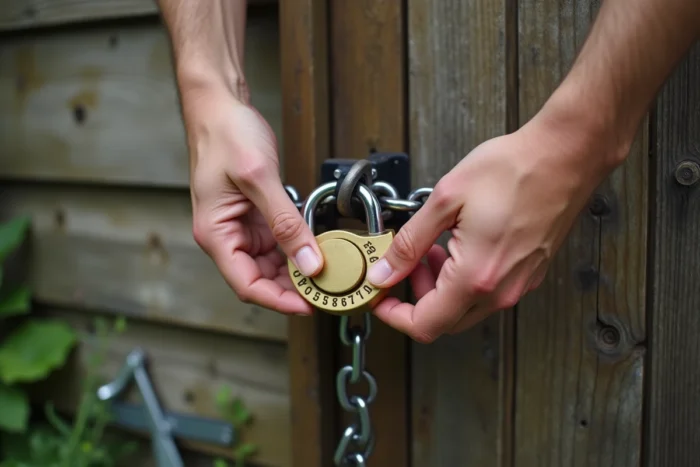
However, the principle remains the same for most cable or chain combination locks: open the lock with the current code, activate a reset mechanism, enter the new code, and then lock it to validate.

Changing a combination lock code: step-by-step method
The process takes less than two minutes. Before you start, keep your current code in mind (or in sight). If you just bought the lock, the default code is usually 0000 or 000 depending on the number of dials.
Cable or chain lock with reset button
Most models sold in supermarkets or sporting goods stores operate with a reset button located near the locking mechanism. Here’s the sequence to follow:
- Enter the current code on the dials and open the lock (pull the shackle or release the cable).
- Locate the reset button, often a small metal or plastic push button housed in the body of the lock. Press it with the tip of a pen if necessary, then hold it down.
- While holding the button, turn the dials to enter your new code. Then release the button.
- Close the lock and test the new code two or three times before using it on your bike.
Combination lock without a visible button
Some locks use the shackle itself as the trigger for the reset. Once the current code is entered, you pull the shackle and turn it a quarter turn (often 90 or 180 degrees depending on the model). The shackle remains locked in the open position until you set the new code.
Enter the new combination, then return the shackle to its original position and close it. If your lock does not match either of these two methods, the manufacturer’s manual remains the only reliable reference.
Choosing a hard-to-guess lock code
Changing the code is pointless if the new combination is as predictable as the old one. The most commonly tested sequences by a thief are well-known: 0000, 1234, 1111, or your birth year if it’s visible on a sticker attached to the frame.
A good code does not follow any logical sequence and contains no repetitions. Mix numbers that have no connection to each other. If your lock has four dials, you have access to 10,000 possible combinations, but most people stick to a few dozen “easy to remember” codes.
A practical tip: choose the last two digits of a close friend’s phone number, followed by the first two digits of another number. You can retrieve the code by checking your contacts, without it being guessable by a third party.
Also, write down your code in a safe place (locked notes app, notebook at home). An forgotten code turns your lock into an obstacle against yourself, and the only solution will then be to cut it.
Combination lock and bike security: the limits to know
Regularly changing your code enhances protection against theft by observation or wear of the dials. However, this action does not change the physical resistance of the lock.
Specialized associations like the Federation of Bicycle Users (FUB) recommend reserving combination locks for short stops or using them as a supplement to a U-lock or certified chain. For an electric bike or a valuable bike, a code-only lock is not sufficient as the main protection.
Experienced thieves can open many combination models without breaking them, by detecting the mechanical play between the dials (slight misalignment or different resistance when the correct number is aligned). This type of vulnerability exists regardless of the code chosen.
Changing the combination remains relevant to counter opportunistic theft, which is the most common. Combine it with two complementary reflexes:
- Always secure the frame (not just the wheel) to a fixed point.
- Use a second lock of a different type (U + combination cable, for example) to complicate and prolong the theft time.
- Ensure that the certification of your main lock corresponds to the value of your bike (SRA or FUB mentions on the packaging or product sheet).
A well-maintained combination lock, with the code changed every two to three months, serves its role as a quick deterrent. It does not replace a security device suitable for prolonged parking or an expensive bike, but it remains a useful link in a multi-level protection strategy.