A skin that feels tight after morning cleansing, redness appearing for no apparent reason, a dull complexion despite applying cream every evening: these situations often reveal a formulation problem rather than a routine issue. Taking care of your skin daily with natural products requires understanding what each ingredient actually brings, and especially what can be expected from so-called natural cosmetics as European regulations are set to tighten the rules.
“Natural” claims on cosmetics: what changes with the European ECGT directive
The term “natural” or “clean beauty” can still be seen on the majority of bottles in pharmacies. Starting from September 27, 2026, the European directive (EU) 2024/825, known as Empowering Consumers for the Green Transition, prohibits generic environmental claims without verifiable proof. Terms like “natural,” “green,” “eco-friendly,” or “biodegradable” can no longer appear on cosmetic packaging unless the brand demonstrates environmental performance throughout the entire product lifecycle.
In France, the AGEC law had already laid the groundwork since 2022 by banning the terms “biodegradable” and “environmentally friendly” on cosmetic packaging. The ECGT directive goes further by requiring adherence to recognized official labels (COSMOS, NATRUE, EU Ecolabel) for any environmental claim.
In practice, when choosing a “natural” face care product, it is now essential to check for certification rather than relying on reassuring packaging. A product certified COSMOS Organic or labeled NATRUE guarantees a controlled specification, which is not the case for a simple “green leaf” logo invented by the brand. You can explore the available ranges on https://www.1tempspourmapeau.fr/ to find products whose formulations meet these criteria.

Natural face care routine: the gestures that truly change the result
It is often said that one must layer serum, cream, oil, and mist to achieve beautiful skin. In practice, three well-executed steps are better than six poorly chosen products. The difference lies in the quality of cleansing, the choice of moisturizing active ingredient, and consistency.
Gentle cleansing morning and evening
Cleansing remains the most underestimated step. A nourishing soap or a plant-based cleansing oil (jojoba, sweet almond) removes impurities without stripping the hydrolipidic film. Avoid sulfate-based foaming gels that give a feeling of cleanliness but leave the skin dehydrated within hours.
In the evening, double cleansing works well for made-up skin: first an oil to dissolve foundation and pollution, then a gentle water-based cleanser. In the morning, a simple application of hydrosol (floral water of rose, cornflower, or chamomile) is often sufficient.
Targeted hydration according to skin type
A common mistake is to apply the same cream all year round. Oily skin needs an aloe vera gel or a light serum. Dry skin requires a richer balm, based on shea butter or argan oil. Adapting hydration to the season and the state of the skin each week yields better results than a single product used out of habit.
Feedback varies on this point, but many combination skin types find their balance by alternating a light cream in the morning and a few drops of vegetable oil in the evening.
Effective natural ingredients: which to choose based on need
Rather than listing all existing natural actives, we focus on those whose daily use produces visible effects within a few weeks.
- Honey: antibacterial and healing, it works as a face mask once or twice a week on blemish-prone skin. Apply it pure for about fifteen minutes, then rinse with lukewarm water.
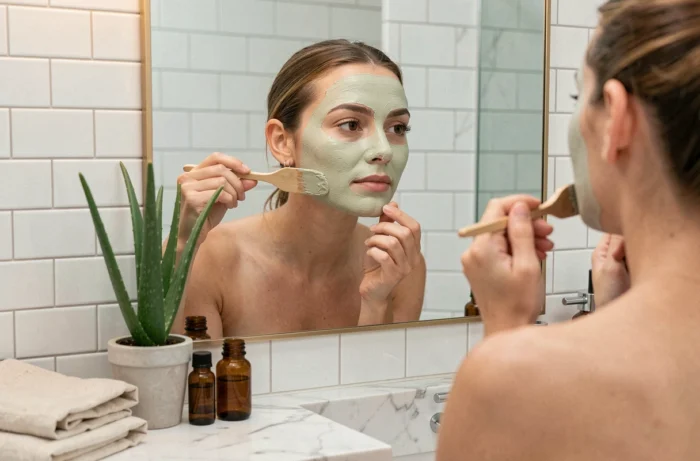
- Green or white clay: green clay absorbs excess sebum on oily skin, while white clay (kaolin) is suitable for sensitive skin. Never let the clay mask dry completely on the face: mist it with water regularly to avoid rebound dryness.
- Black seed oil: less known than argan oil, it has interesting anti-inflammatory properties for acne-prone skin. A few drops mixed with night cream are sufficient.
- Aloe vera: an immediate moisturizer, it soothes redness and tightness. It is available in pure gel, to be applied before oil or cream to enhance absorption.
Weekly natural mask: the frequency that makes a difference
A well-formulated natural mask, applied once a week, acts as a reset for the skin. A common mistake observed is to multiply masks (scrub on Monday, clay on Wednesday, honey on Friday) thinking it will speed up results. Too many active treatments weaken the skin barrier instead of strengthening it.
For a realistic routine, stick to a maximum of one mask per week. On combination to oily skin, a mask of green clay mixed with a bit of honey and floral water yields a clear result. On dry skin, a honey-avocado mask nourishes deeply without being aggressive.
Mechanical scrubs (coffee grounds, fine sugar) remain useful for smoothing the skin texture of the body, but should be avoided on the face if the skin is reactive. An enzymatic scrub based on papaya or pineapple offers a gentler exfoliation, suitable for bi-monthly use.
Natural products for the body and hair: the same principles applied differently
The skin on the body is thicker than that on the face, allowing for the use of richer textures and mechanical exfoliants without risk. Applying shea butter on still damp skin after a shower creates an effective protective film, especially in winter. For hair, vegetable oils (coconut, castor, avocado) should be applied as an oil treatment before shampooing, not after.
A often overlooked point: hard water is as damaging to skin and hair as poorly formulated products. A final rinse with vinegar water (diluted apple cider vinegar) on the hair closes the cuticles and restores shine. On the face, finishing with a mist of hydrosol after rinsing with tap water helps restore the skin’s pH.
Adopting natural products daily does not require overhauling your entire bathroom in a week. Replacing one product at a time, observing your skin’s reaction over three weeks, and then adjusting: this is the method that lasts over time.