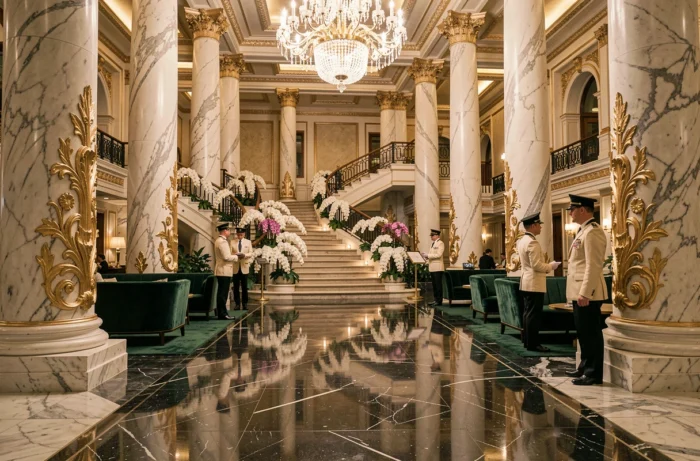
No national or international hotel classification body recognizes a category beyond five stars. The terms “7 stars” or “8 stars” have no regulatory value: they are part of a marketing strategy promoted by the establishments themselves or by specialized media. Understanding this gap between official classification and commercial positioning is essential to evaluate what the ultra-luxury segment truly encompasses.
Official hotel classification: why the scale stops at 5 stars
Almost all national classification systems cap at five stars. In South Korea, the Tourism Promotion Act and its revised implementing decree in July 2026 set a strictly limited scale of 1 to 5 stars, with a scoring system of 1,000 points. The “7-star” label is explicitly described as a mere marketing term without regulatory value.
Abu Dhabi follows a similar trajectory. The hotel classification manual there is undergoing a complete overhaul, with finalization announced for the second quarter of 2026. This update introduces specific distinctions (environmental excellence, Emirati hospitality), but does not create any category beyond 5 stars.
These recent developments show that authorities are now directly responding to the proliferation of “7” or “8 stars” labels. We observe that the informal category known as “8 stars” relies on a set of tangible services (staff-to-guest ratio, suite size, private concierge services) that are not subject to any standardized audit. To explore 8-star hotels around the world, one must decode the criteria that each establishment assigns to itself.

Implicit criteria of the ultra-luxury segment: what the self-proclaimed label entails
The absence of an official grid does not prevent the segment from structuring around recurring markers. By analyzing the establishments that claim this label, we identify a core set of common services that distinguish them from the classic five-star palace.
- A staff-to-guest ratio that far exceeds that of a conventional palace, often with a dedicated butler per suite and teams available around the clock
- Suites whose size surpasses that of many urban apartments, including private pools, integrated spas, and sometimes helipads or private maritime access
- A gastronomic offering led by multi-starred chefs, with menus tailored for each client and sourcing of rare products (Iranian saffron, certified Wagyu beef)
- Non-reproducible immersive experiences: private diving on a coral reef closed to the public, safari with a dedicated biologist, exclusive access to heritage sites off the tourist circuit
The price per night serves as a natural filter: these establishments charge prices that effectively exclude the “standard” luxury clientele. The night in a suite consistently exceeds the psychological threshold that separates a palace from the ultra-luxury segment.
Dubai and Abu Dhabi: self-proclaimed epicenter of limitless luxury
The Gulf concentrates a notable proportion of hotels claiming the “7” or “8 stars” status. The Burj Al Arab, often cited as the world’s first “7-star” hotel, initiated this logic of media overclassification. Its duplex suites, dizzying atrium, and underwater restaurant established the visual codes of the segment.
Since then, other properties in the region have pushed the envelope further. The Emirates Palace in Abu Dhabi operates on a similar logic, with an institutional positioning (state receptions, diplomatic summits) that justifies levels of security and personalization unattainable in classic hospitality.
This phenomenon is not confined to the Gulf. Properties in Southeast Asia, the Indian Ocean, and Southern Africa adopt comparable positions without using the “star” terminology. They prefer proprietary labels (“beyond luxury,” “ultra-premium”) that circumvent the regulatory question while targeting the same clientele.
Spa, pool, and tailored experiences: the markers of differentiation
The spa in these establishments is not limited to a treatment menu. We observe facilities integrating preventive medicine, cryotherapy, and sleep programs supervised by specialists. The pool, often infinity with panoramic views, is part of a private aquatic complex including an artificial beach or landscaped lagoon.
The customer experience relies on anticipation rather than reaction. Staff memorize the preferences of regular guests before their arrival. Rooms are configured according to a detailed profile: temperature, lighting, pillow selection, minibar contents.
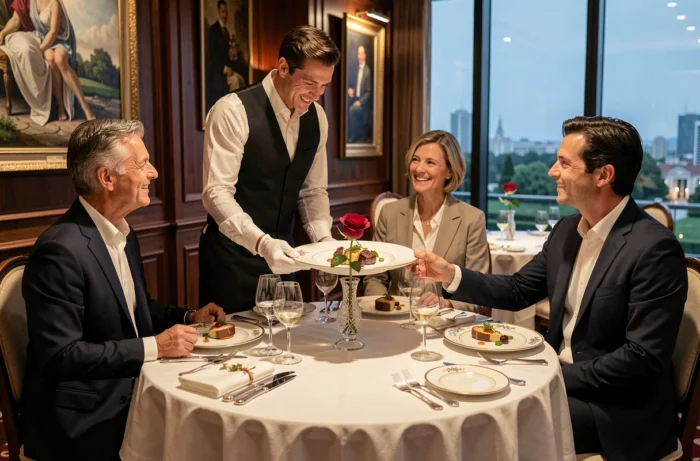
Staying in an ultra-luxury hotel: what the discerning traveler should check
The self-proclaimed label guarantees nothing in the absence of independent certification. Before booking a stay at an establishment that presents itself as “8 stars,” several elements deserve careful examination.
Verified reviews on travel platforms remain a reliable indicator, provided recent stays are filtered. A hotel may have earned its reputation ten years ago and lost service quality since a management change. The consistency of recent reviews matters more than the overall rating.
The price displayed per night rarely includes local taxes, service fees, or surcharges related to premium experiences. In some Gulf jurisdictions, tourist taxes add a significant proportion to the final amount. Checking the details before confirmation avoids discrepancies between marketing promises and budget realities.
The “8 stars” category remains a commercial construct, but it reflects a market reality: a segment of the global clientele seeks services that structurally exceed the framework of a five-star palace. As long as classification bodies do not extend their grid, this segment will continue to operate on trust, reputation, and word-of-mouth among wealthy travelers.